 ultimate-guide
Portable Restrooms for Outdoor Wedding Venues
Table of Contents
- Why Outdoor Wedding Locations Require Portable Restrooms
- How Many Porta Potties for Wedding Guests
- Portable Restroom Rental for Weddings: Trailer vs. Standard Unit
- Luxury Wedding Restroom Trailer Cost: What Drives the Price
- Placement, Power, and Water: Site Logistics Most Couples Miss
- Permits, Weather, and Guest Communication
- Frequently Asked Questions
Last Updated: October 1, 2026
Why Outdoor Wedding Locations Require Portable Restrooms
Portable restrooms are a non-negotiable line item for any outdoor wedding, and the reason is simple: guests will need them, and the venue usually has none. This guide from Patriot Solutions walks through unit counts, trailer versus standard units, cost drivers, and the site logistics that quietly sink otherwise well-planned events.
A barn, a meadow, a family ranch, or a lakeside field all share the same problem. There is no plumbing. Renting portable restrooms solves it, but only if you size the order correctly and plan for delivery, power, and water before the week of the wedding. Most couples book a venue and a caterer first, then treat sanitation as an afterthought. That order is backwards.
The Centers for Disease Control and Prevention guidance on sanitation for mass gatherings treats adequate toilet access as a basic public health requirement at any event where people gather for several hours. A wedding runs six to eight hours with food and alcohol. Plan accordingly.
How Many Porta Potties for Wedding Guests
The working rule for how many porta potties for wedding guests you need is one standard unit per 50 guests for a four-hour event, plus one additional unit for every two hours beyond that. A 150-guest wedding with a five-hour reception lands at four standard units as a baseline.
Several factors push that number up:
- Alcohol service, which increases restroom frequency
- A reception longer than four hours
- Guests spread across a large site, requiring units in more than one location
- A meal served on-site rather than a short ceremony only
If your venue has no indoor restrooms at all, add a dedicated unit for vendors and staff so they are not competing with guests.
Portable Restroom Rental for Weddings: Trailer vs. Standard Unit
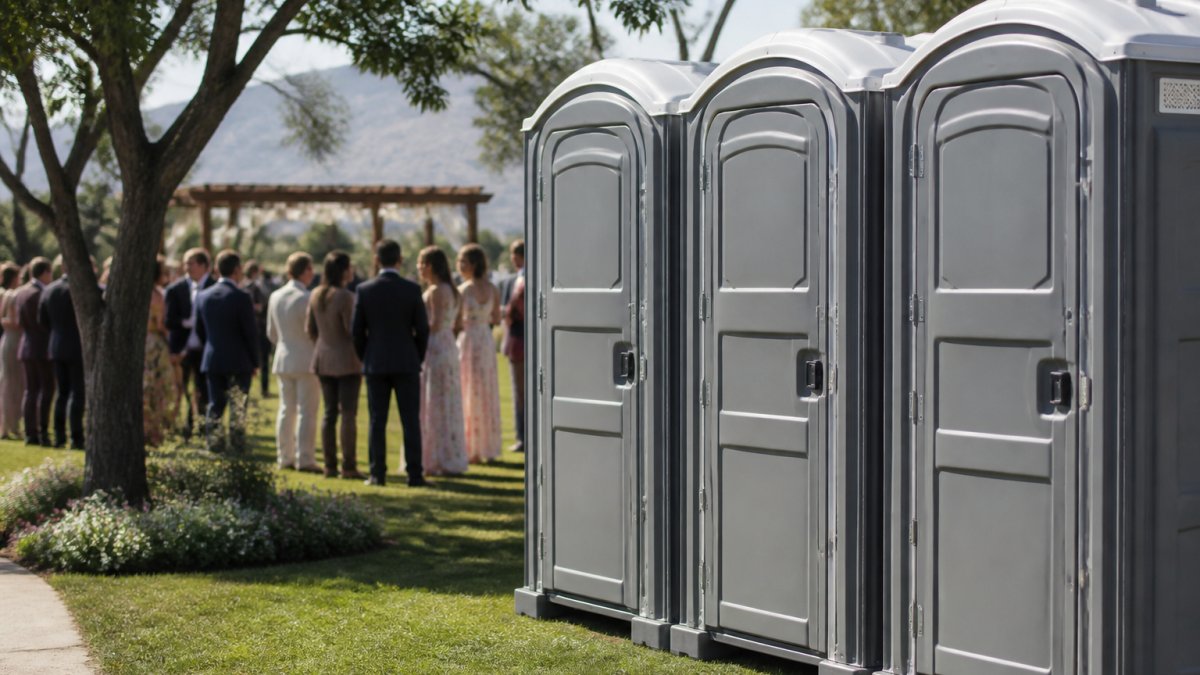
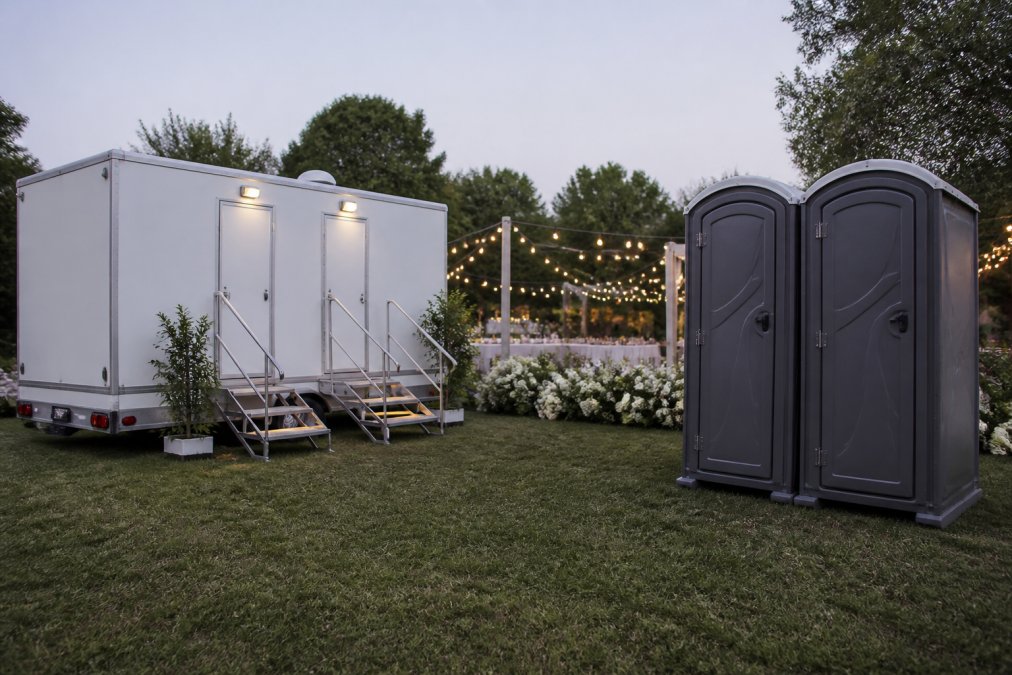
Portable restroom rental for weddings splits into two categories: standard units and restroom trailers. The choice changes the guest experience more than any other sanitation decision you will make.
| Feature | Standard Unit | Restroom Trailer |
|---|---|---|
| Footprint | Small, fits tight spaces | Large, needs level ground |
| Water | Recirculating, no hookup | Fresh water tank or hookup |
| Power | None required | Generator or outlet needed |
| Guest experience | Functional | Comparable to indoor restrooms |
| Best for | Short or casual events | Weddings and formal gatherings |
Luxury Wedding Restroom Trailer Cost: What Drives the Price
Luxury wedding restroom trailer cost depends on trailer size, rental duration, delivery distance, and whether the site needs a generator or water hookup. There is no single flat rate, and any quote you see online for a different market will not reflect what applies to your venue.
The main cost drivers:
- Trailer size. A two-station trailer costs less than a ten-station model. Larger guest counts need larger trailers, or multiple units.
- Rental duration. A one-day wedding rental prices differently than a multi-day festival or a weekend with setup and teardown.
- Delivery and setup. Distance from the provider matters, and rural venues often carry a higher delivery charge.
- Power and water. If the site has no outlet or water source, you are paying for a generator and a fresh-water fill.
- Service level. Mid-event pump-outs and restocking add cost but prevent a mid-reception failure.
Placement, Power, and Water: Site Logistics Most Couples Miss
Site logistics decide whether your sanitation plan actually works on the day. Three requirements trip up more couples than any others: placement, power, and water. Most wedding guides wave at these topics without explaining the mechanics. This section covers the numbers you actually need to confirm with your venue and your rental provider.
Placement
Units need level ground, a slope of more than a few degrees makes trailers unstable and causes waste to pool on one side of a standard unit's tank. Plan for vehicle access wide enough for the delivery truck and, later, the pump-out truck. A loaded restroom trailer can weigh several thousand pounds, so a gravel or dirt access road that looks fine in dry weather can fail after rain.
Power
Standard portable units need no power at all, they are self-contained. Restroom trailers are a different animal. A typical event trailer runs on 110-120 volt, 20-amp service for lighting and ventilation, and larger trailers with air conditioning or multiple pumps may need a 30-amp or 50-amp circuit, the same service a recreational vehicle or a food truck uses. Some trailers run on a standard household outlet; others require a dedicated circuit that a venue's outdoor outlet may not provide.
Water
Trailers either carry a fresh-water tank or connect to a hose bib. A two-station trailer may carry enough fresh water for a short event, but a larger trailer with flush toilets and sinks can empty its fresh tank and fill its waste tank faster than couples expect. Ask your provider for the fresh-water capacity and the waste-tank capacity in gallons, and compare that to your guest count and event length.
Permits, Weather, and Guest Communication
This is the part of planning most guides skip entirely, and it is where weddings actually go wrong. Permitting, weather, and guest communication are three separate problems that share one trait: they are invisible until they fail.
Permits and Local Regulations
Portable sanitation at a gathering is regulated at the state and county level, and sometimes at the city level, so there is no single national rule. What you will encounter most often:
- Temporary-use or special-event permits. Many jurisdictions require a permit for any temporary structure or portable sanitation unit placed on public land, and some require one on private land if the event is open to the public or exceeds a certain guest count.
- Health department sanitation requirements. Local health departments often set minimum toilet ratios for permitted events, commonly one toilet per 50 guests for events under four hours, with additional units for longer events and for alcohol service. These ratios can be stricter than the rental industry's general rule of thumb.
- Setback and placement rules. Some jurisdictions restrict how close units can be to property lines, food service areas, or water features.
- Waste disposal rules. Pump-out waste must go to an approved treatment facility. Your provider handles this, but confirm they are permitted to operate in your county.
Weather-Proofing
Weather-proofing matters in a place with real seasons, and the failure modes are different by season.
- Heat. Trailers with air conditioning need adequate power and shade. Standard units can become unusable in direct sun, place them under trees or a canopy, and make sure vents are not blocked.
- Rain. Units placed in low spots can flood or sink. Choose ground that drains, and avoid placing units at the bottom of a slope. Mud around the entry is a slip hazard for guests in formal shoes.
- Wind. Lightweight standard units should be anchored or strapped if high wind is possible. Trailers are heavier but still need the wheels chocked and the tongue supported.
- Cold. In freezing conditions, fresh-water lines and tanks can freeze. If your event is in late fall or winter, ask your provider about heated trailers or freeze protection.
Guest Communication
Guest communication is the last piece, and it is where tact matters. Tell guests where the restrooms are before they need them:
- Add a short note to the invitation or the wedding website, something like "Restrooms are located near the reception tent" is enough.
- Place signage at the ceremony exit and along the path to the units, with lighting so the route is obvious after dark.
- Include the accessible unit location for guests who need it, and make sure the route to it is firm, level, and step-free.
- Brief your coordinator, DJ, or officiant so they can mention the restroom location during the event if needed.
Frequently Asked Questions
How many porta potties do I need for a 100-person wedding?
For a 100-guest wedding lasting four hours, plan for at least two to three standard units, or one to two restroom trailers with multiple stalls. If alcohol is served, add one extra unit. For events over six hours, increase the count by 20 to 30 percent. Always confirm the venue's existing facilities before finalizing your portable restroom order.
How much does a luxury wedding restroom trailer cost to rent?
Luxury restroom trailer pricing depends on trailer size, rental duration, delivery distance, and whether you need power or water hookups. A two-stall trailer costs less than a ten-stall unit with climate control and running water. Patriot Solutions can provide a quote based on your guest count and venue location. Contact them directly for current pricing.
How far in advance should I book portable restroom rental for weddings?
Book at least four to six weeks before your wedding date, especially for peak season (May through October). Luxury trailers and ADA-compliant units go first. If your venue is rural or requires a long delivery distance, book eight weeks out. Last-minute availability exists but options shrink fast, and you may pay more for rush delivery.
What should I check before choosing an outdoor wedding venue that needs portable restrooms?
Confirm whether the venue has power outlets, water access, and a clear delivery path for a truck and trailer. Ask about permit requirements for temporary sanitation units. Check that the ground is level and firm enough to support a loaded trailer. Also verify the venue allows portable restrooms and whether any placement restrictions apply near the ceremony or reception area.