 ultimate-guide
Sanitation Requirements for Organic Produce Farms
Quick Summary
Organic produce farms must meet two separate systems: USDA National Organic Program certification for inputs and soil, and FDA Produce Safety Rule standards for sanitation, hygiene, and water. Passing one does not satisfy the other, so farms should keep separate compliance tracks and records.
- Covered farms must address worker training and hygiene, agricultural water, equipment, and buildings.
- Farms with a three-year average above $25,000 in produce sales are covered unless a qualified exemption applies.
- Qualified exemptions require produce labeling and records, and eligibility must be reviewed at least annually.
- Water testing schedules, source inventories, and corrective-action records should be kept in writing.
- One binder with two tabs can hold both organic and food-safety records, reducing duplicate work.
Table of Contents
- Which Farms Must Follow the FDA Produce Safety Rule
- Farm Worker Hygiene Requirements in the Field and Packing Area
- Agricultural Water Testing for Produce Farms
- Cleaning and Sanitizing Tools, Equipment, and Food-Contact Surfaces
- Produce Packinghouse Sanitation Checklist
- Organic Certification Recordkeeping Requirements and Your Next Steps
- Frequently Asked Questions
How Organic Certification and Food Safety Rules Fit Together
Organic certification and food-safety regulation are two separate systems, and many organic produce farms mix them up. Organic certification is governed by the USDA National Organic Program and focuses on what goes into the soil and onto crops. Food-safety rules focus on keeping pathogens off produce. Meeting one does not satisfy the other.
The USDA Economic Research Service counted approximately 17,181 certified organic operations in 2025, and U.S. sales of certified organic products reached $76.6 billion that year, up 6.8% from the prior year. That growth makes reliable production and handling practices more important, not less. USDA Economic Research Service organic agriculture data, 2025
Here is the practical split. Organic rules cover approved inputs, soil management, and records that prove a product came from a certified system, which is why organic produce farms keep those records separate from their food-safety logs. The FDA Produce Safety Rule sets minimum standards for growing, harvesting, packing, and holding produce, including sanitation and water practices. A farm can be fully certified organic and still fail a food-safety inspection, and the reverse is also true.
Watch out: treating an organic certificate as proof of food safety is the most common gap we see. Keep the two compliance tracks separate in your planning and your binders.
Which Farms Must Follow the FDA Produce Safety Rule
The FDA Produce Safety Rule, the food-safety rule under the Food Safety Modernization Act, sets science-based minimum standards for growing, harvesting, packing, and holding produce for human consumption. Whether it applies to you depends on three things: what you grow, how much you sell, and to whom.
Step 1: Is your crop covered produce? The rule covers produce that is generally eaten raw. It does not cover produce that is rarely consumed raw (for example, crops grown only for cooking or processing), produce grown for personal or on-farm consumption, or produce that receives a commercial kill step before it reaches consumers.
Step 2: Are you a covered farm? A farm is covered if it sells more than a rolling three-year average of $25,000 in produce (adjusted for inflation) and does not qualify for a qualified exemption. The $25,000 is the floor; below it, the rule does not apply. Above it, keep reading.
Step 3: Do you qualify for a qualified exemption? Two pathways exist:
- Direct-to-consumer and local sales. If your average annual produce sales are under $500,000 (adjusted for inflation) and more than half of those sales go directly to consumers, or to a qualified end user such as a local restaurant or retail establishment in the same state or within 275 miles, you may qualify for a qualified exemption.
- Sales threshold. If your average annual produce sales are under $500,000 and you meet the direct-sale or local-sale test above, you fall into the qualified exemption category.
A qualified exemption is not a free pass. It comes with modified requirements: you must label your produce with your farm name and business address (unless you sell directly to consumers), and you must keep records that support your exemption.
Step 4: What does coverage actually require? Covered farms must address worker training and health and hygiene, agricultural water, biological soil amendments of animal origin, domesticated and wild animals, equipment, tools, and buildings, and sprouts (if you grow them). Each of those areas has its own standards and its own records. The practical move is to map each standard to a written procedure and a log, then assign an owner.
How this interacts with organic certification. Organic certification does not exempt you from the Produce Safety Rule, and Produce Safety Rule compliance does not satisfy organic requirements. They are separate tracks with separate records.
FDA FSMA Final Rule on Produce Safety, including coverage, exemptions, and modified requirements
USDA National Organic Program, organic regulations and certification
The rule's coverage tests come down to three checks, summarised below.
| Test | What to check | Outcome |
|---|---|---|
| Covered crop | Typically eaten raw | Assume covered until confirmed |
| Sales floor | Rolling three-year average above $25,000 | Below floor: rule does not apply |
| Qualified exemption | Average sales under $500,000 and direct or local sales | Modified labeling and records apply |
Farm Worker Hygiene Requirements in the Field and Packing Area
Worker hygiene is the single easiest place for pathogens to enter the food chain, and it is also the easiest place to fix.
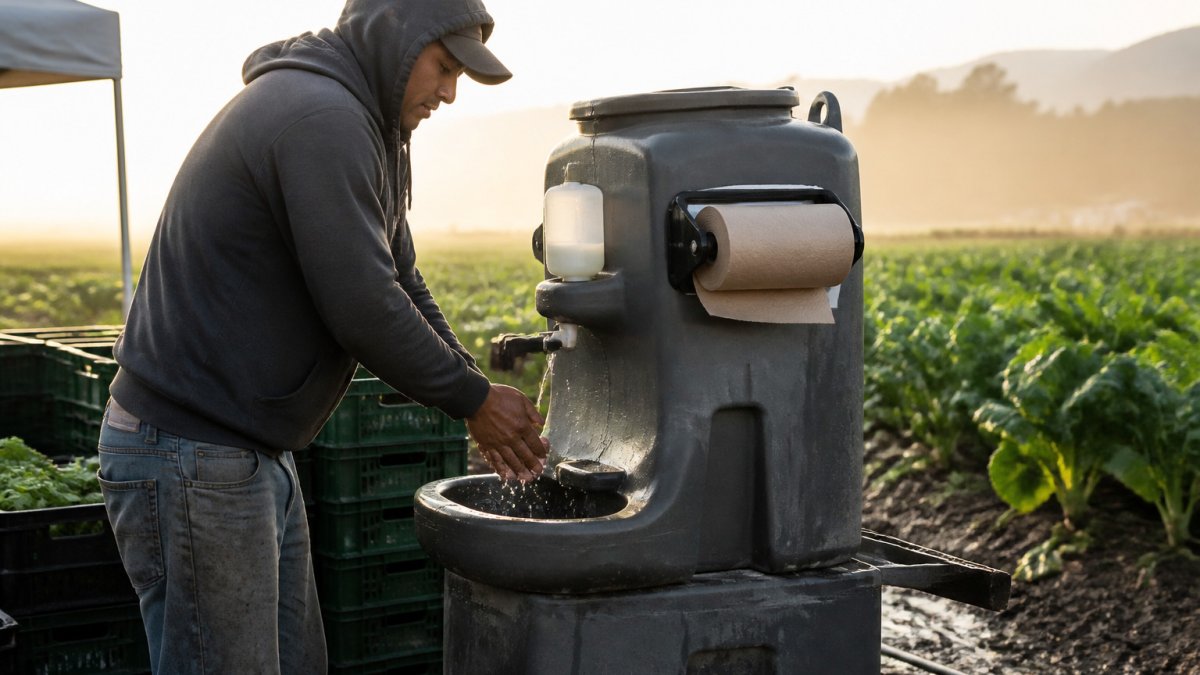
Handwashing that actually gets used. Place handwashing stations at every field entrance, at the edge of each harvest block, and at the packinghouse door. In the field, portable restroom units with handwashing capability can be delivered to your site.
Toilet and handwashing facilities. Provide toilets that are accessible, clean, and stocked, and locate them so workers do not have to leave the harvest area for long. Handwashing facilities must be right next to the toilets, not across the yard.
Illness reporting. Adopt a simple rule: any worker with diarrhea, vomiting, jaundice, a sore throat with fever, or an infected wound on the hand must report it to a supervisor before starting work. The supervisor decides whether the worker is reassigned away from produce contact or sent home.
Training frequency and content. Train workers before they handle produce and at least once a year after that, plus whenever a procedure changes. Cover handwashing technique, toilet use, illness reporting, the importance of clean clothing and footwear, and what to do about cuts and wounds.
Visitors and non-farm personnel. Visitors, buyers, and delivery drivers can carry contamination in on shoes and hands. Require sign-in, provide clean footwear or boot covers in packing areas, and route visitors away from harvest and wash areas unless they are following the same hygiene rules as workers.
How this fits with organic certification. Organic rules do not prescribe worker hygiene procedures, but your organic system plan must describe your handling practices, and inspectors increasingly expect sanitation and hygiene to be documented. A single hygiene program with one training log and one illness-report log can serve both your organic certifier and your food-safety records. Keep the logs in the same binder as your water tests and sanitation schedules so nothing gets lost between programs.
FDA Produce Safety Rule, standards for worker training and health and hygiene
Agricultural Water Testing for Produce Farms
Agricultural water is a direct contamination pathway when it contacts produce, whether through irrigation, crop spraying, or washing. Testing and documenting water quality is a core part of produce-safety compliance, and it is a point where organic growers often have the least documentation.
Keep a written water source inventory, a testing schedule, and records of results and any corrective actions. The University of Massachusetts Amherst Extension treats farm sanitation as beginning with housekeeping practices meant to keep harvested produce from becoming contaminated, and water management sits within that same preventive mindset. UMass Amherst Extension post-harvest handling and sanitation guidance
Cleaning and Sanitizing Tools, Equipment, and Food-Contact Surfaces
Harvest bins, knives, totes, conveyors, and packing tables all touch produce, so they need a written cleaning and sanitizing schedule. A 2023 assessment of on-farm produce safety practices in Texas reported growers who did not clean and sanitize equipment used to transport produce, which is exactly the kind of gap inspectors look for. For debris and waste from cleanup work, roll-off dumpster rentals in Delta and Central Utah can haul material away. On-Farm Produce Safety Practices Assessment in Texas, Food Protection Trends, 2023
Document each surface, the cleaner or sanitizer used, the contact time, and who signs off. For debris and waste from cleanup work, a roll-off dumpster can haul material away so it does not pile up near production areas.
Produce Packinghouse Sanitation Checklist
Use this checklist as a starting point for your packinghouse. Adapt it to your equipment and product mix.
- Floors, drains, and walls cleaned on a written schedule
- Wash water changed and sanitizer levels checked and logged
- Food-contact surfaces cleaned and sanitized before each shift
- Pest control devices inspected and results recorded
- Handwashing stations stocked with soap, water, and single-use towels
- Waste removed from packing areas daily
- Corrective actions documented for any failed check
Organic Certification Recordkeeping Requirements and Your Next Steps
Organic certification requires records that trace inputs, seeds, soil amendments, and harvest lots. Food-safety compliance requires its own logs for sanitation, water testing, training, and corrective actions. Keep both sets in one organized system so an inspector from either program can find what they need quickly.
Start this week by listing every covered activity on your farm, assigning an owner to each sanitation task, and setting up a log template for each. Then confirm your coverage status with the FDA and your certifier, and schedule a review before the next harvest. Organic certification and produce safety are both manageable when the records are kept current.
Last Updated: October 27, 2026
Frequently Asked Questions
What sanitation requirements apply to organic produce farms?
Organic produce farms must meet USDA organic standards under 7 CFR Part 205, which govern inputs, handling, and recordkeeping, and may also fall under the FDA Produce Safety Rule. Sanitation expectations generally cover growing, harvesting, packing, and holding, including worker hygiene, water quality, and cleaning of tools and surfaces. Organic certification does not replace food-safety requirements, so farms should review both sets of rules and document how each practice is met.
Do organic farms have to follow the FDA Produce Safety Rule?
Coverage depends on farm size, sales volume, and the crops grown, and some farms qualify for exemptions or modified requirements. The FDA Produce Safety Rule sets minimum standards for growing, harvesting, packing, and holding produce. Organic certification is voluntary and is a separate matter from food-safety regulation, so an organic farm should check its status under the FDA rule directly and keep records that show compliance.
What handwashing facilities are required for farm workers?
Farms should provide handwashing stations with running water, soap, and single-use towels that are accessible in the field and near harvest and packing areas. Workers should wash hands before handling produce, after using the restroom, and after handling soil amendments or cleaning chemicals. Keeping these facilities stocked and maintained is a practical way to show that worker hygiene practices are followed consistently.
What water testing is required for organic produce farms?
Agricultural water used for irrigation, washing, and pesticide application should be assessed for microbial quality, and testing frequency depends on the water source and how it is used. The FDA Produce Safety Rule includes requirements for agricultural water, and farms should keep test results and corrective actions on file. Farms unsure about their testing schedule can contact their state extension office for guidance.
What sanitation records should an organic farm keep?
Organic farms should keep records of input materials, cleaning and sanitizing schedules, water test results, worker training, and corrective actions taken when problems arise. These records support both organic certification audits and food-safety compliance. Keeping logs current and organized makes inspections easier and helps the farm demonstrate that practices are carried out as written.
Can cleaning products be used on an organic farm?
Only cleaning and sanitizing products that are allowed under USDA organic standards may be used where they could contact organic crops, soil, or handling surfaces. The farm should check each product against the National List of allowed and prohibited substances before use. Keeping product labels and documentation on file helps the farm show that its cleaning inputs comply with organic rules.