 how-to
How Many Portable Toilets Do You Need for Your Guests?
Last Updated: November 2, 2026
Quick Summary
Most planners start with one portable toilet for every 50 guests at a four-hour event, then adjust upward for longer duration, alcohol, and food service. Build your portable toilet needs from guest count, event length, and service level rather than a single rule.
- Divide your guest count by 50 for a four-hour event, then round up.
- Add one unit per 50 guests for events of 4 to 6 hours.
- Apply a service multiplier of 1.4 to 1.6 for a full bar, applied once.
- Plan for peak demand before ceremonies, between courses, and near bar closing.
- Place accessible units on a firm, level surface with a route at least 36 inches wide.
Table of Contents
- How Many Portable Toilets Do You Need for a Standard Four-Hour Event?
- Adjusting Your Count for Event Duration Beyond Four Hours
- How Alcohol and Food Service Change Restroom Demand
- Planning for Peak Use, Queues and Accessible Units
- Portable Toilet Rental Requirements for Construction Sites
- ADA Portable Toilet Requirements and Accessible Unit Placement
- Booking Your Portable Restroom Order With Patriot Solutions
- Frequently Asked Questions
How Many Portable Toilets Do You Need for a Standard Four-Hour Event?
Most event planners start with one simple rule: one portable toilet for every 50 guests at a four-hour event. That number is the most common starting point in published planning guides, including A Royal Flush's guide on how many porta potties an event needs. Use it as your baseline for portable toilet needs before adjusting for anything else.
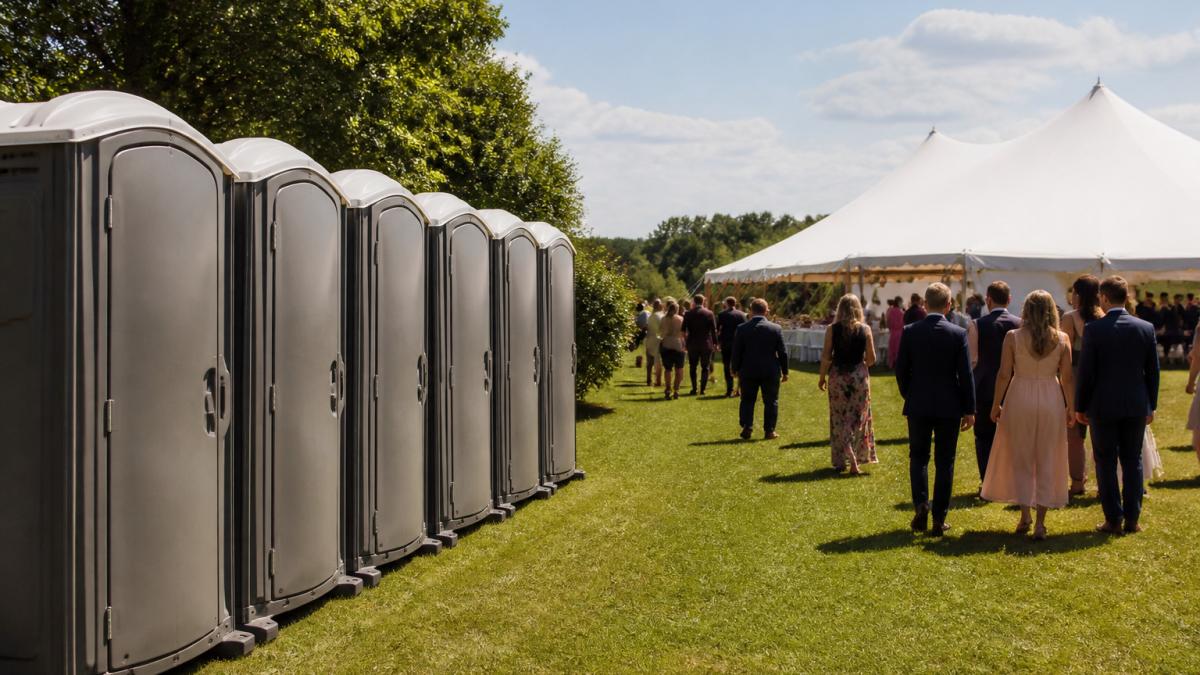
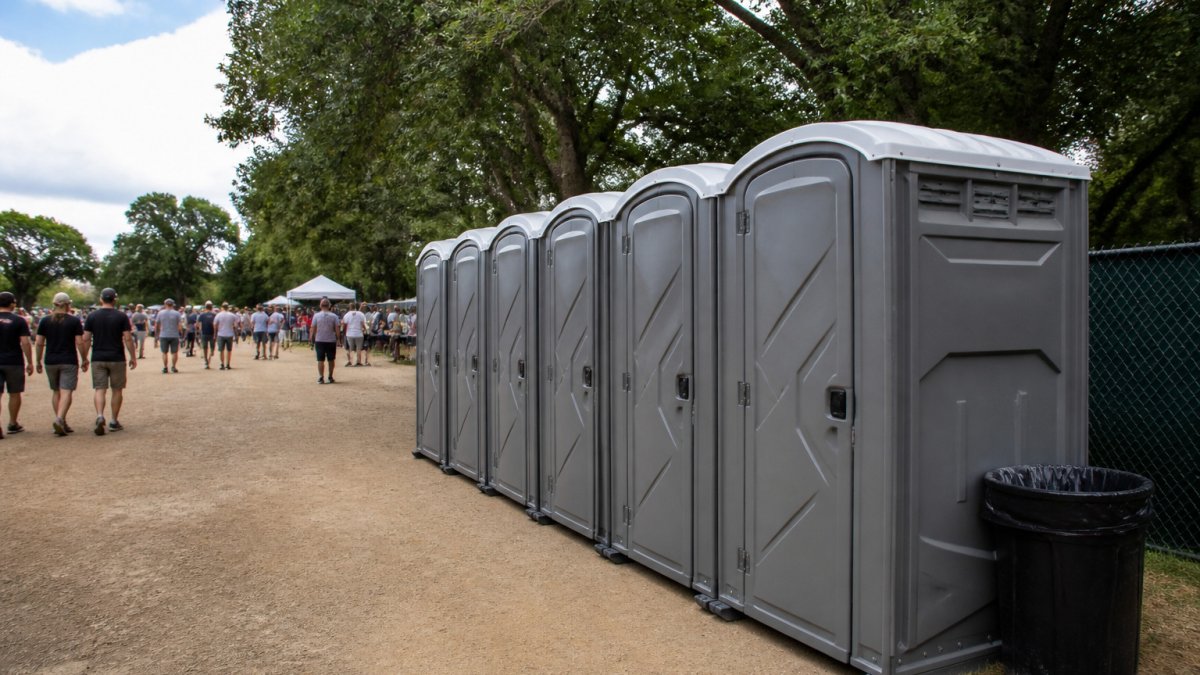
!A row of portable restroom units at an outdoor wedding venue with guests arriving on a sunny lawn
Here is how to calculate your count:
- Write down your expected guest count.
- Divide by 50 for a standard four-hour event.
- Round up to the next whole unit.
So a 200-guest event needs four units as a starting point. A 75-person backyard wedding needs two units, which keeps your setup small but still practical.
Not every source agrees on the ratio. The ratio can vary with assumptions about drinking, food service, and how long guests stay. We recommend 1 per 50 as the safer default, then adjusting upward for the factors below.
Adjusting Your Count for Event Duration Beyond Four Hours
The four-hour ratio assumes guests use the restrooms at a steady pace. Longer events change that pattern. A common approach is to add units for longer events, since demand grows with time on site.
- Events up to 4 hours: 1 unit per 50 guests
- Events of 4 to 6 hours: add 1 unit per 50 guests
- Events of 6 to 8 hours: add 2 units per 50 guests
- All-day events: plan for extra units and a midday servicing visit
Longer events also mean more trips, so servicing matters as much as the count. Plan for at least one mid-event pump-out on any event lasting more than six hours.
How Alcohol and Food Service Change Restroom Demand
Alcohol and food service are the two variables that most often push a correctly sized event into a queue. The reason is mechanical: alcohol is a diuretic, so guests who drink visit the restroom more often than guests who do not, and they tend to stay at the event longer. Food service adds a second wave of demand because guests drink more with a meal and because buffet or coffee stations keep people circulating rather than seated.
Rather than rely on a single add-on rule, build the estimate from inputs you can actually state. A transparent method looks like this:
- Start with the baseline count for your guest total and duration (see the four-hour ratio above).
- Add a service multiplier: no alcohol and no food service = 1.0; food service only = 1.1 to 1.2; beer and wine = 1.25 to 1.4; full bar or cocktails = 1.4 to 1.6.
- Multiply the baseline by the multiplier and round up.
- Add accessible units separately (covered below) rather than folding them into the multiplier.
Worked example: a 200-guest, five-hour reception with a full bar. The baseline for four hours is 4 units; the extra hour adds roughly 1 unit, giving 5. A full-bar multiplier of 1.5 turns that into 7.5, which rounds up to 8 units. The same event with beer and wine only (1.3) lands at 6.5, or 7 units.
A common pattern is that plated, seated dinners spread usage across a shorter window than buffets, because guests leave their seats in a burst when the buffet opens and again when plates are cleared. Cocktail hours concentrate demand even more: guests stand, drink, and socialize for 60 to 90 minutes before the main program, which is exactly when queues form.
Watch out: applying an alcohol multiplier on top of a duration adjustment that already assumes steady usage can double-count demand. Pick one baseline, apply the duration adjustment, then apply the service multiplier once.
If your event includes a bar, confirm with the venue whether glass, open flames, or alcohol service triggers additional requirements, and check whether the venue has its own restroom-count minimum that supersedes your estimate.
The article's service multipliers show how much the count rises with alcohol and food service.
| Service level | Multiplier | Example result |
|---|---|---|
| No alcohol, no food service | 1.0 | Baseline count |
| Food service only | 1.1 to 1.2 | Slight increase |
| Beer and wine | 1.25 to 1.4 | 6.5 units for a 200-guest, five-hour event |
| Full bar or cocktails | 1.4 to 1.6 | 8 units for the same event |
Planning for Peak Use, Queues and Accessible Units
A correct total count can still produce a visible queue. Demand is not spread evenly across an event; it clusters around predictable moments. The most common peaks are the 15 to 20 minutes before a ceremony starts, the break between courses, the toast or program intermission, and the last 30 minutes before the bar closes. During those windows, a unit that serves 50 guests over four hours may serve 15 to 20 guests in 20 minutes.
Plan for the peak, not the average. A practical approach is to identify your two or three highest-demand windows and ask whether your unit count can absorb a burst. If your event has a seated ceremony followed immediately by a cocktail hour, treat the transition as a peak and place at least one unit on the path between the two areas so guests do not have to cross the whole site.
Queue length also depends on who is in line. A common pattern at events with a mixed-guest list is that the women's line runs longer than the men's line, because more guests use the same number of stalls and because clothing and accompaniment (children, bags) slow turnover. If your guest mix skews female, weight your count toward additional standard units rather than assuming the total is sufficient.
Accessible units need their own allocation and placement plan, not a single add-on. Placement matters as much as count:
- Put the accessible unit on a firm, level surface (pavement, packed gravel, or a matted path), not on grass that softens with rain or foot traffic.
- Keep the route at least 36 inches wide and free of cables, tent stakes, and temporary fencing.
- Avoid slopes, loading areas, and the bottom of a grade where water collects.
- Mark the unit on your site map and, for large sites, add signage at the main entrance and near the program area.
Watch out: placing an accessible unit at the far edge of the site to 'keep it out of the way' defeats the purpose. Guests who use mobility devices, walkers, or strollers need the shortest practical route, and event staff should know where the unit is so they can direct guests.
For events with older guests, young children, or guests with disabilities, add a second accessible unit and place it near the seating area rather than only near the entrance. Confirm any venue-specific accessibility requirements before finalizing placement, since some venues impose their own route and surface standards.
Portable Toilet Rental Requirements for Construction Sites
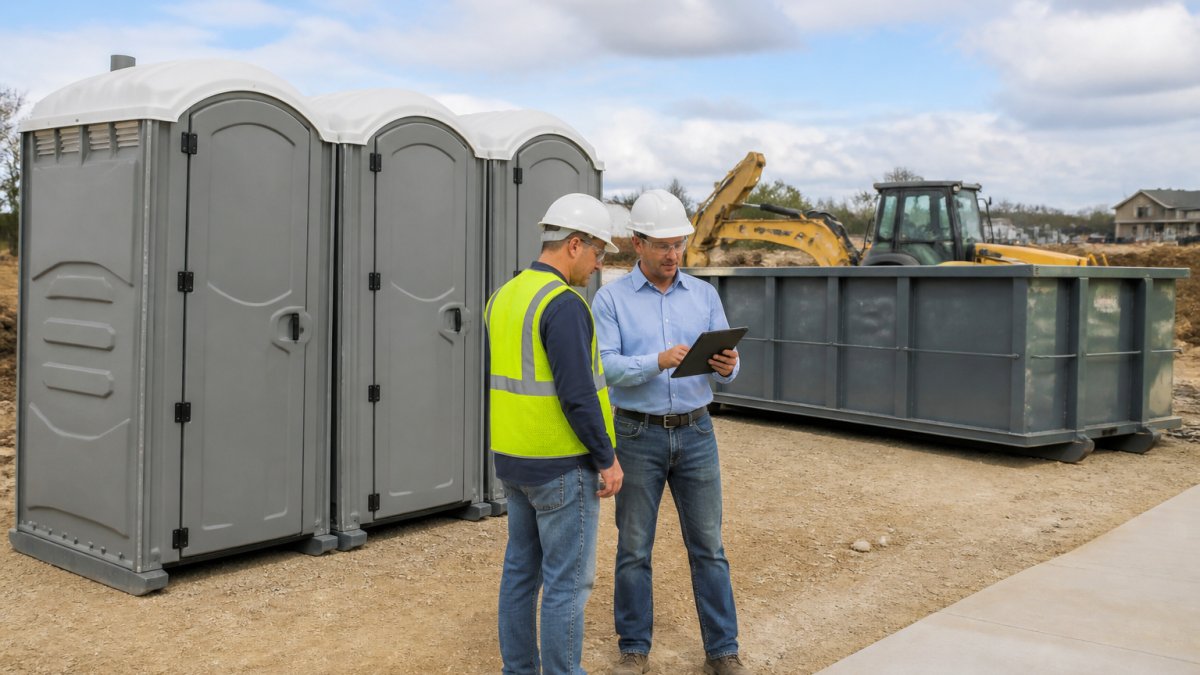
Construction sites follow different rules than events. Headcount is usually the number of workers on site, not guests.
Check your local jurisdiction and project contract, since requirements vary. We recommend confirming the exact count with the general contractor before ordering.
ADA Portable Toilet Requirements and Accessible Unit Placement
Accessible facilities must be considered for the public and workers where a project requires them. Confirm the applicable accessibility requirements with your project's guidelines before you place your order.
Place accessible units on a level, paved surface with a route free of obstacles. Avoid placing them at the bottom of a slope or behind a loading area.
Booking Your Portable Restroom Order With Patriot Solutions
Once you have your guest or worker count, your duration, and your accessible unit plan, you are ready to order. Patriot Solutions provides portable restrooms and roll-off dumpsters for the Delta, Utah area, with clean equipment and dependable local service.
Pricing depends on quantity, dates, and delivery. Contact Patriot Solutions for current prices and a quote tailored to your event.
Frequently Asked Questions
How many portable toilets do you need for 100 people?
For a four-hour event, the common planning ratio is one portable toilet per 50 guests, which points to two units for 100 people. Some industry sources use a less conservative one unit per 100 attendees, so the ratios do not fully agree. If the event runs longer, serves alcohol, or has a long program with a single peak window, plan for a third unit. Patriot Solutions can review your guest count, schedule and site layout and recommend a quantity for your event.
Is one porta potty enough for 60 guests?
One unit for 60 guests is below the usual one-per-50 guideline for a four-hour event, so most planners would add a second unit. A single unit can work for a short gathering of about two hours with little alcohol service. For longer events or events with food and drink, two units are the safer choice to limit queues. Contact Patriot Solutions for a recommendation matched to your timeline.
Does the duration of an event change how many portable toilets I need?
Yes. The baseline ratio covers events up to four hours. Beyond that, one common guideline adds one unit for every two additional hours. Guests also use restrooms more often when alcohol or food is served, so longer events with those services need more capacity. Servicing frequency matters too, since a unit that fills up mid-event creates the same problem as too few units.
Are there specific requirements for ADA-compliant portable toilets at events?
Accessible portable toilets must be included in your order so guests with disabilities have a usable option. Accessible units should sit on an accessible route, with level ground, clear turning space and the required accessible features. Confirm current federal accessibility requirements under the Americans with Disabilities Act and any local rules that apply to your event. Patriot Solutions can advise on accessible unit placement for your site.
Need restrooms for your event or site? Browse our portable restroom rental options and call Patriot Solutions to plan your delivery and servicing schedule.