 how-to
Can I Rent a Dumpster for Dirt? Yes, Here's How
Table of Contents
- Yes, You Can Rent a Dumpster for Dirt: What You Need to Know First
- How to Calculate Cubic Yardage for Your Soil Removal
- Understanding Dirt Removal Weight Limits
- Clean Fill Dumpster Rental: What Qualifies and What Doesn't
- Choosing the Right Roll-Off Container Size for Heavy Dirt
- Dumpster Rental for Landscaping Projects: A Step-by-Step Guide
- Dirt Dumpster Costs, Permits, and How to Avoid Overage Fees
- Conclusion
- Frequently Asked Questions
Last Updated: September 6, 2026
Yes, You Can Rent a Dumpster for Dirt: What You Need to Know First
Yes, you can rent a dumpster for dirt, but it is not the same as renting one for household junk. Dirt is heavy, and weight capacity determines everything from dumpster size to final price. Most providers allow clean fill soil but enforce strict limits because exceeding them creates safety hazards and expensive overage fees.
How to Calculate Cubic Yardage for Your Soil Removal
Before renting, know how much dirt you are removing. Dumpster sizes are measured in cubic yards. The formula: multiply length by width by depth in feet, then divide by 27.
For example, a garden bed 20 feet long, 5 feet wide, and 2 feet deep contains 200 cubic feet, or roughly 7.4 cubic yards, meaning you need at least a 10-yard container.
A common mistake is measuring only the visible pile. If excavating a foundation, pool, or utility trench, the hole itself is your measurement. Account for soil expansion: excavated dirt "fluffs up" and takes up more space than it did in the ground.
Understanding Dirt Removal Weight Limits
Weight limits are the most misunderstood part of dirt removal. A standard roll-off dumpster might hold 10 cubic yards of household trash, but the same container holds only a fraction of that in dirt. Soil is dense: depending on moisture, a cubic yard of fill dirt can weigh well over a ton.
Every dumpster has a maximum weight capacity, typically stated as a total limit for the container and its contents. Exceeding that limit triggers overage fees, and in severe cases, the hauler cannot legally transport the load on public roads. Federal Motor Carrier Safety Administration guidelines on commercial vehicle weight limits set the legal maximums that every hauling service must respect.
The practical takeaway: you rarely fill a dirt dumpster to the rim. A 10-yard container might be limited to 2 to 3 yards of soil before hitting its weight ceiling.
| Material | Approximate Weight per Cubic Yard | Typical Restriction |
|---|---|---|
| Topsoil (dry) | 1.5 - 2,200 lbs | Usually allowed as clean fill |
| Fill dirt (dry) | 2,000 - 2,500 lbs | Usually allowed as clean fill |
| Wet or clay soil | 2,500 - 3,000+ lbs | Heaviest loads, strict limits |
| Rock and concrete | 2,500 - 3,000+ lbs | Often requires separate container |
Clean Fill Dumpster Rental: What Qualifies and What Doesn't
A clean fill dumpster rental restricts the container to uncontaminated soil and natural materials: plain dirt, topsoil, sand, gravel, and rock. It excludes anything classified as contaminated or hazardous waste, which requires specialized disposal.
The distinction matters because clean fill goes to specific disposal sites, while contaminated soil requires environmental compliance measures that most standard dumpster rentals do not cover. Environmental Protection Agency guidance on contaminated soil disposal explains that soil containing petroleum products, chemicals, or construction debris like treated lumber often requires special handling.
"Clean" is a legal term, not a visual one. Soil that looks fine might contain residue from a former structure, buried waste, or naturally occurring materials that some disposal sites reject. If excavating land with unknown history, a soil test is a smart investment before booking.
How to Identify Potential Contamination Before You Rent
Most residential projects involve obviously clean soil, but certain situations should raise red flags. Assess your site before calling a provider:
- Proximity to old structures: Soil near a house built before 1978 may contain lead-based paint chips or asbestos from old siding and insulation. If you are excavating around a foundation or demolition site, assume the soil is not clean fill.
- Former use of the land: Was the property ever a gas station, auto repair shop, dry cleaner, or agricultural field? These uses often leave behind petroleum hydrocarbons, solvents, or pesticide residues that classify the soil as hazardous waste.
- Visual and olfactory cues: Discolored soil, an oily sheen, or a petroleum or chemical smell are obvious signs of contamination. Black, tar-like material or buried debris also disqualifies the load.
- Underground storage tanks: If you are excavating near where a heating oil tank once sat, the surrounding soil is very likely contaminated. Leaking tanks are one of the most common sources of residential soil contamination.
- Naturally occurring hazards: In some regions, naturally occurring asbestos or elevated levels of heavy metals like arsenic exist in the native soil. Disposal sites in those areas test incoming loads and may reject soil that exceeds background levels.
What Happens If Your Soil Is Contaminated?
If your soil fails the visual and historical checks, a standard dumpster rental is not the right solution. Contaminated soil must go to a permitted hazardous waste landfill or treatment facility at dramatically higher cost. Most residential projects that uncover contamination work with an environmental remediation contractor who handles sampling, manifesting, and transport.
If contamination is discovered mid-excavation after the dumpster is on site, stop loading immediately and call your provider. Do not mix contaminated soil with clean fill. Mixing materials can turn an entire load into hazardous waste, multiplying disposal costs.
The Cost of a Soil Test vs. the Cost of a Rejected Load
A basic soil screening for common contaminants typically runs $100 to $300 per sample. That is modest compared to the alternative: if a disposal site rejects your load, you pay for a second hauling trip, the disposal fee, and potentially a fine. In many jurisdictions, improper disposal penalties start in the thousands of dollars.
For most residential projects, a full soil test is overkill. But if your property has any risk factors above, the test is cheap insurance. Ask your local extension office or a private consultant about options; many labs offer screening packages for petroleum hydrocarbons, heavy metals, and volatile organic compounds.
Choosing the Right Roll-Off Container Size for Heavy Dirt
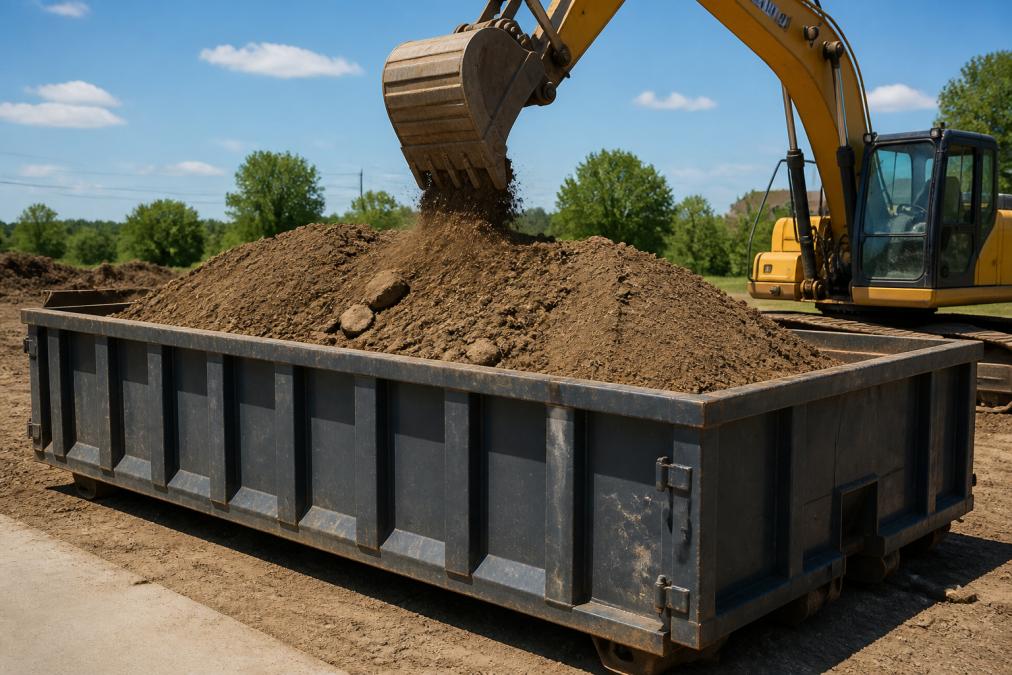
A roll-off container is the standard dumpster type for dirt removal, with sizes ranging from 10 to 40 cubic yards. For residential landscaping or small excavations, a 10 or 15-yard container is usually the right starting point. Commercial foundation work or large grading jobs may need 20 or 30-yard containers.
With dirt, you choose a container based on weight capacity, not just volume. A larger container might seem like a better deal, but if you cannot fill it without exceeding weight limits, you are paying for unusable space. Discuss your cubic yardage with your provider and let them recommend the size that balances volume against weight.
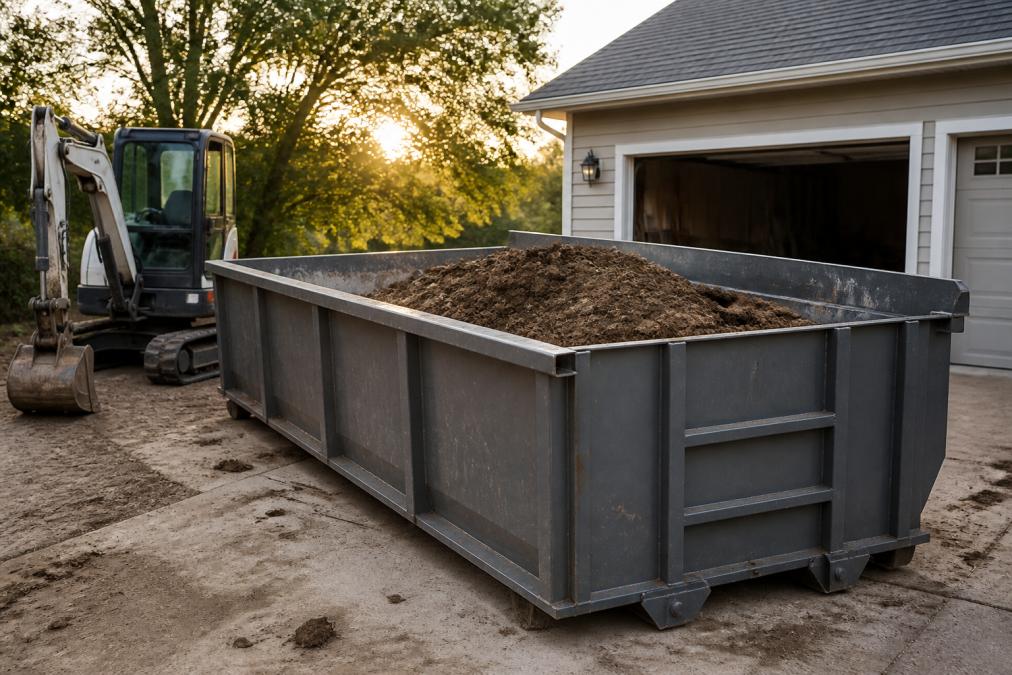
For most homeowners excavating a basement, removing a pool, or regrading a yard, starting with a 10 or 15-yard container is often recommended. These fit on a standard driveway and handle several cubic yards of soil without special permits for the delivery truck. For larger projects, ask about delivery logistics, since bigger containers need more clearance.
Dumpster Rental for Landscaping Projects: A Step-by-Step Guide
A dumpster rental for landscaping follows the same core process as any other rental, but with extra attention to weight and material restrictions. Whether removing an old garden bed, clearing land for a patio, or excavating for a pond, the steps below keep the job on track.
Step 1: Measure your project area. Walk the site and calculate cubic yardage using the length-width-depth formula. Mark the boundaries of the excavation so you do not underestimate the volume.
Step 2: Identify your soil type. Determine whether you are moving topsoil, fill dirt, clay, or a mix. Clay and wet soil weigh significantly more per yard than dry topsoil, which affects how much you can load.
Step 3: Call your provider with your numbers. Give them your cubic yardage and soil type. Your provider uses this information to recommend the right container size and confirm it fits your delivery location.
Step 4: Schedule delivery and prepare the site. Clear the driveway or drop-off area. Confirm there is at least 60 feet of straight-line access for the delivery truck and no low-hanging branches or wires.
Step 5: Load strategically. Heavier loads require careful distribution. Place soil evenly across the container floor rather than piling it in one corner, and never fill above the rim line.
Step 6: Schedule pickup. Call for pickup when the container is at its weight limit, even if it is not full to the top. Do not wait until the last day of your rental period to discover the load is too heavy.
Dirt Dumpster Costs, Permits, and How to Avoid Overage Fees
Dirt dumpster costs depend on container size, rental duration, delivery distance, and local landfill disposal fees. The accurate way to budget is to request a quote based on your specific cubic yardage and soil type. Providers offer transparent pricing that includes delivery, pickup, and a set rental period.
Overage fees are where most customers get burned. These charges apply per ton over the agreed weight limit. To avoid them, be honest about your soil type when booking. Wet clay is much heavier than dry topsoil, and guessing wrong can double your bill.
Permits are another common surprise. If the dumpster must sit on a public street, alley, or sidewalk rather than your private property, most municipalities require a permit. Local municipal guidelines on dumpster placement permits vary by city and county, so check with your local public works department before delivery. Containers placed entirely on a private driveway or job site typically do not need a permit.
Dumpster Rental vs. Professional Hauling: Which Is Cheaper?
Most homeowners assume a dumpster rental is the cheapest way to remove dirt, but that is not always true. For smaller volumes, hiring a local hauler or using a bag-based disposal service can be more cost-effective. The decision comes down to volume, access, and labor.
When a dumpster rental makes sense:
- You are removing more than 3 to 4 cubic yards of soil.
- You have a driveway or job site where the container can sit without a permit.
- You can load the dirt yourself or with a small crew over several days.
- You are already renting equipment like a skid steer or excavator for the excavation work.
When professional hauling is cheaper:
- You are removing less than 2 to 3 cubic yards of soil. A dumpster rental includes delivery, pickup, and disposal fees that are hard to justify for a small volume.
- You do not have a place to set a dumpster. If you would need a street permit and the container would block traffic, the permit cost plus the hassle may exceed the savings.
- You cannot load the dirt yourself. If you would need to hire labor to fill the dumpster, a professional hauler who brings a truck with a hydraulic arm may cost about the same and save you the physical work.
For a 5-cubic-yard project, a 10-yard dumpster rental might run $350 to $550, while a professional hauling service with a small dump truck might charge $400 to $700. The dumpster wins on price, but the hauler wins on convenience. For a 1 to 2-cubic-yard project, a local hauler or a pickup truck trip to a clean fill site is the smarter move.
How to Get an Accurate Quote
When you call for pricing, the provider needs three numbers: cubic yardage, soil type, and moisture level. If you do not know the soil type, describe what you saw when you dug. If it rained recently or you are digging below the water table, say so. Wet soil can weigh 20 to 30 percent more than dry soil.
A provider that asks these questions is protecting you from overage fees. A provider that quotes a flat price without asking about soil type is either building in a buffer or setting you up for a surprise charge. The cheapest quote is not always the best deal if it lacks enough weight allowance.
Local Disposal Fees and How to Check Them
Disposal fees at the landfill or clean fill site are a significant part of your total cost and vary widely by region. Some municipalities charge as little as $20 per ton for clean fill, while others charge $50 or more. Ask your provider which disposal site they use and whether the quoted price includes the tipping fee.
You can check local disposal rates by calling your city or county public works department or visiting their website. Many publish rate sheets listing charges per ton for clean fill, construction debris, and municipal solid waste. Knowing these rates helps you spot providers padding the disposal line item.
Permit Requirements by Placement Type
Permit requirements vary by municipality, but the general rule is consistent: private property, no permit; public right-of-way, permit required. If the dumpster sits on your driveway or private land, you almost never need a permit. On the street, sidewalk, or alley, most cities require a permit costing $25 to $150 for a typical residential rental period.
Some cities restrict how long a dumpster can occupy a public street, often 7 to 14 days. If your project takes longer, you may need to renew the permit or move the container. Check with your local public works department before delivery and ask about permit validity.
Conclusion
Renting a dumpster for dirt is absolutely possible, but it demands more planning than a standard junk removal job. Calculate your cubic yardage first, understand that weight limits cap how much you can load, and confirm your soil qualifies as clean fill before you book. Those three steps prevent overage fees and rejected loads.
For homeowners and contractors in the Delta, Utah area, Patriot Solutions provides essential sanitation services, specializing in portable restrooms and roll-off dumpsters. We are committed to delivering clean, high-quality equipment paired with fast, dependable local service to meet your project needs. Our team prioritizes reliability and responsibility, ensuring you receive professional support you can count on every time. Get started with Patriot Solutions and get your excavation debris hauled away without the guesswork.
Frequently Asked Questions
Can I put dirt in a rental dumpster?
Yes, most rental companies allow dirt in roll-off dumpsters, but it must be clean fill. This means the soil is free from trash, construction debris, or hazardous materials. You should confirm with the provider before booking, since some locations have restrictions on contaminated soil. For large amounts, dirt is one of the few materials you can typically dispose of this way, but weight limits will determine how much you can load.
Why are there weight limits for dirt in dumpsters?
Dirt is one of the heaviest materials you can put in a dumpster, often weighing around 2,000 to 3,000 pounds per cubic yard when wet. Trucks and dumpsters have legal weight limits for safe transport on roads. Exceeding them creates a safety hazard and results in overage fees. Always discuss your project's cubic yardage with the rental company so they can recommend the right container size for the weight.
Is it cheaper to rent a dumpster or haul dirt yourself?
It depends on your volume and access to a disposal site. Renting a dumpster is usually more cost-effective for anything over a few cubic yards because you avoid multiple trips, fuel costs, and potential disposal fees at the landfill. For a small weekend project under one cubic yard, hauling it yourself in a pickup truck might be cheaper. For anything larger, a dumpster rental saves time and protects your vehicle.
What happens if a dumpster is overloaded with soil?
An overloaded dumpster cannot be legally transported, so the rental company will not pick it up until you remove the excess soil. You will also face overage fees based on how much the load exceeds the agreed-upon weight limit. To avoid this, estimate your cubic yardage carefully and always confirm the weight capacity with your provider before you start filling the container.