 How-to
Farm Food Safety Compliance Requirements Explained
Last Updated: November 9, 2026
Quick Summary
Farm food safety compliance starts with the FDA's Produce Safety Rule, which covers farms that grow, harvest, pack, or hold produce for sale and sets science-based minimum standards for those operations. Farms averaging $25,000 or less in annual produce sales are fully exempt, while others may qualify for a qualified exemption based on sales to qualified end users. Covered farms need a written plan, trained workers, and records that prove both.
- A qualified exemption requires food sales to qualified end users to exceed half of total average annual food sales.
- Qualified end users are consumers and local restaurants or retailers in the same state or within 275 miles.
- At least one supervisor or responsible party must complete food safety training recognized under the rule.
- A GAP audit is voluntary under the law but often mandatory under a buyer contract.
- The FDA proposed extending the traceability compliance date by 30 months, to July 20, 2028.
Table of Contents
- Who Must Comply With Farm Food Safety Rules
- Produce Safety Rule Exemptions and How to Calculate Them
- A Produce Safety Rule Checklist for Covered Farms
- Building a Farm Food Safety Plan Template That Holds Up
- Produce Safety Alliance Training and Worker Qualifications
- Legal Compliance, GAP Audits, and Buyer Standards Are Not the Same
- Recordkeeping, Corrective Actions, and Incident Response
- Sanitation Support for Your Farm Crew
- Frequently Asked Questions
Who Must Comply With Farm Food Safety Rules
Farm food safety compliance requirements start with one question: does the FDA's Produce Safety Rule cover your operation? If you grow, harvest, pack, or hold produce for sale, the answer is likely yes.
The rule sets science-based minimum standards for growing, harvesting, packing, and holding covered produce, according to the FDA's Produce Safety Rule overview. It comes from the Food Safety Modernization Act, or FSMA.
Coverage hinges on three things:
- Whether your produce is "covered" under the rule
- Your average annual produce sales
- Whether you sell to qualified end users
Most mid-size farms are covered. Small farms may qualify for an exemption. We'll calculate that next.
Produce Safety Rule Exemptions and How to Calculate Them
Two exemption paths exist under the Produce Safety Rule: qualified exemption and full exemption. Both turn on sales numbers and recordkeeping, not intentions, so the calculation has to be done on paper and kept on file.
Full exemption
A farm is fully exempt from the Produce Safety Rule if its average annual produce sales during the previous three-year period are $25,000 or less (adjusted for inflation). The FDA adjusts this threshold annually, so confirm the current figure on the FDA's Produce Safety Rule page before you rely on it. A farm at or below the threshold is not covered, but it still has to keep records that show it stays below the line.
Qualified exemption
A qualified exemption is a two-part test. You compare two three-year averages:
- Your average annual produce sales over the prior three years.
- Your average annual food sales to qualified end users over the same three years.
Qualified end users are consumers, and local restaurants or retailers, that are located in the same state as the farm or within 275 miles of the farm (the FDA).
Worked example: a farm with $400,000 in average annual food sales, of which $260,000 goes to consumers at a farmers market and a nearby grocery within 275 miles, passes the qualified-end-user test because $260,000 is more than half of $400,000.
Documentation and annual review
A qualified exemption is not permanent. You must keep records that demonstrate you still qualify, and you must review eligibility annually. The records need to show sales by buyer type and location so the qualified-end-user share can be recalculated.
Organic growers face an extra layer of questions, since organic certification interacts with Produce Safety Rule duties and exemptions. Our guide on sanitation requirements for organic produce farms walks through that overlap.
A Produce Safety Rule Checklist for Covered Farms
A covered farm needs a written plan, trained workers, and records that prove both. Here is the core checklist we walk crews through:
- Written farm food safety plan on file
- Agricultural water tested and results logged
- Biological soil amendments handled with required waiting periods
- Animal intrusion monitored and documented
- Worker health and hygiene training completed
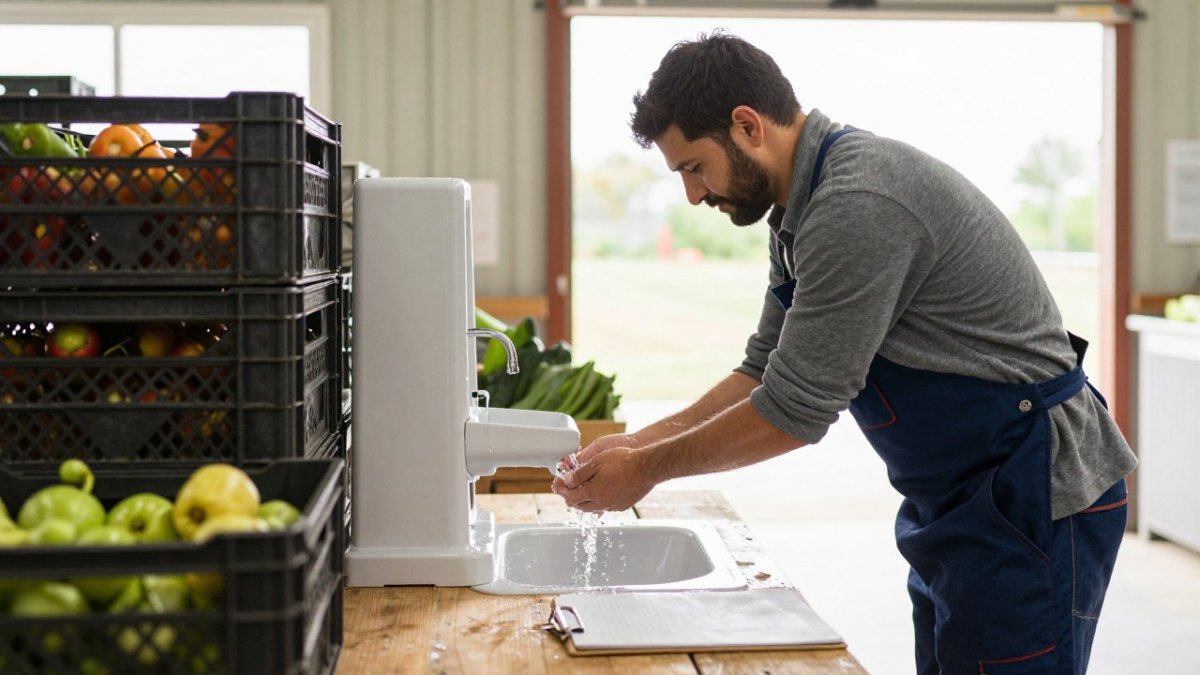
- Handwashing stations stocked and accessible
- Sanitation logs for equipment, tools, and packing facilities
- Corrective action records for any contamination event
Water, Soil Amendments, and Animal Intrusion
Agricultural water is the risk area most farms underestimate. You need water quality data, and you need it on file. Testing frequency and thresholds depend on your water source and use.
Raw manure and compost carry their own rules. Biological soil amendments of animal origin require application timing that limits contamination risk. Track application dates and crop harvest dates together.
Wild and domestic animals can introduce contamination at any point. Walk your fields and note intrusion signs. Document what you find and what you did about it.
Worker Health, Hygiene, and Sanitation
Worker health and human hygiene are where compliance meets daily reality. Covered farms must train workers on handwashing, illness reporting, and sanitation practices.
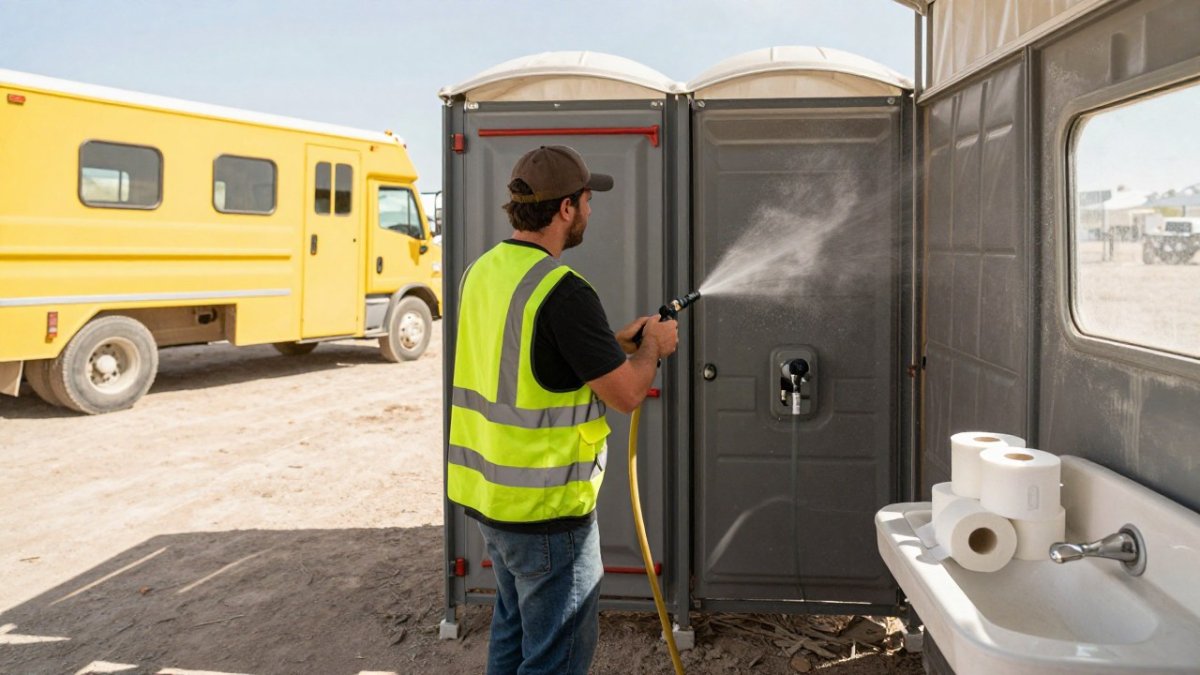
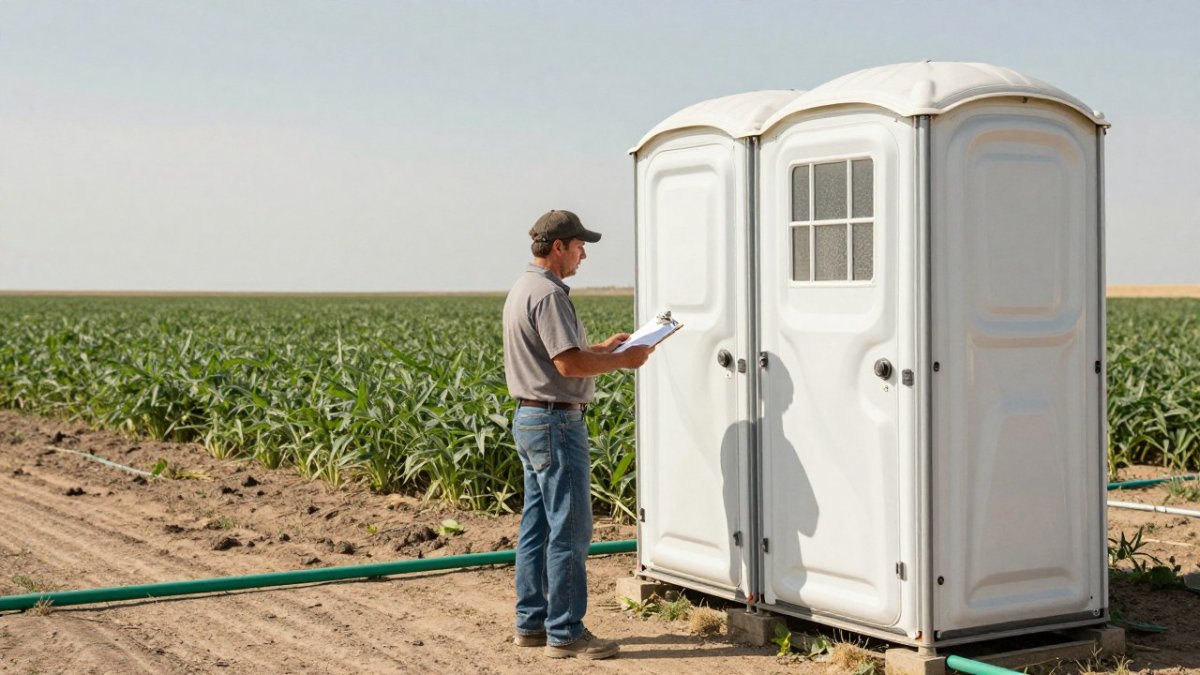
That training only works if the facilities exist. Crews need accessible toilets and handwashing stations in the field, not just at the barn. Our farm worker hygiene best practices guide covers the practical setup.
Building a Farm Food Safety Plan Template That Holds Up
A farm food safety plan template is only useful if it matches your actual operation. Generic templates fail inspections because they describe a farm that isn't yours. The practical approach is to build the plan in a fixed sequence so each section feeds the next.
Step-by-step build sequence
- Write the farm profile first: crops, acreage, water sources, packing and holding facilities, and the person responsible for food safety. Everything else references this profile.
- Map water: list every source and every use (irrigation, harvest, packing, handwashing), then attach the testing schedule and results to each.
- Document soil amendments: materials used, source, application dates, and the interval to harvest for each crop.
- Write the worker health and hygiene policy: training dates, illness reporting, and where supplies are stocked.
- Build the sanitation schedule: what gets cleaned, how often, with what, and who signs off.
- Add animal intrusion monitoring: where you walk, what you look for, and how findings are logged.
- Finish with the records index: where each log lives and who maintains it.
What the plan must document
| Plan Section | What It Must Document |
|---|---|
| Farm profile | Crops, acreage, water sources, facilities, responsible person |
| Water | Sources, uses, testing schedule, results |
| Soil amendments | Materials used, application timing, source records, harvest interval |
| Worker health | Training dates, illness policy, hygiene supplies |
| Sanitation | Cleaning schedule, equipment logs, packing facility routine |
| Animals | Intrusion monitoring, corrective actions |
| Records | Where each log lives and who maintains it |
Sample log entries
A water test log entry should record the date, source, test method, result, and the name of the person who reviewed it. A worker training sign-in sheet should record the date, trainer, topics covered, and each worker's signature. A sanitation log should record the equipment or area cleaned, the date and time, the cleaning method, and the initials of the person who did it. A corrective action entry should record the problem found, the date, the immediate fix, the root cause, and the follow-up check.
Name a responsible person and pre-write corrective actions
The plan should name a responsible person who owns the records and signs off on corrective actions. It should also describe your corrective actions before you need them, so a failed water test or an animal intrusion finding triggers a known response rather than an improvised one.
Watch out: plans that list corrective actions only in general terms tend to produce no usable record when an incident happens. Write the specific trigger and the specific follow-up for each risk area in advance.
Produce Safety Alliance Training and Worker Qualifications
At least one supervisor or responsible party must complete food safety training recognized under the rule. The Produce Safety Alliance course is the standard option most growers use.
Training is not a one-time box. New hires need hygiene training before they touch produce. Seasonal crews need refreshers each season.
A common mistake is training supervisors and skipping the crew. The people handling produce are the people who prevent contamination.
Legal Compliance, GAP Audits, and Buyer Standards Are Not the Same
Legal compliance is the floor. Buyer requirements sit above it, and this is where many farms get surprised.
The Michigan Organic Farming Exchange notes that FSMA is a minimum requirement and buyers may impose additional programs, such as Good Agricultural Practices. A third-party GAP audit is voluntary under the law but often mandatory under a contract.
So you can be fully compliant with the Produce Safety Rule and still lose a buyer who wants a GAP certificate. Know which standard your distributor actually requires before you invest in an audit.
Recordkeeping, Corrective Actions, and Incident Response
Records are what separate a compliant farm from a farm that says it's compliant. Every log you keep should answer three questions: what happened, when, and who checked.
Keep these records current:
- Water test results and dates
- Soil amendment application and harvest timing
- Worker training sign-in sheets
- Sanitation and cleaning logs
- Animal intrusion observations
- Corrective actions for any problem found
When something goes wrong, document the fix. A corrective action record shows an inspector you found the issue and resolved it. Missing records read as missing controls.
Traceability rules add another layer for certain foods. The FDA proposed extending the traceability compliance date by 30 months, to July 20, 2028, per its traceability rule update.
Sanitation Support for Your Farm Crew
Sanitation is the part of farm food safety compliance requirements that crews feel every day. Toilets, handwash stations, and waste handling have to work in a field, not just on paper.
Patriot Solutions provides portable restrooms and roll-off dumpsters for farms and job sites in the Delta area. We focus on clean equipment, fast delivery, and dependable local service.
Our sanitation services for rural farm crews guide explains how to set up units and service schedules.
If you're booking restrooms for a remote field, start with the portable restroom service guide for rural farms. And if your operation sits outside town, confirm coverage through our portable toilet service for rural areas page before you commit.
Compliance work stalls when the sanitation side isn't ready.
Frequently Asked Questions
Which farms must comply with the FDA Produce Safety Rule?
The rule covers farms that grow, harvest, pack, or hold produce normally eaten raw. Compliance depends on average annual produce sales, adjusted for inflation. Very small farms average no more than $25,000, small farms no more than $500,000, and all other farms above that. Farms below the $25,000 threshold are not covered. Operations that average under $500,000 and sell mostly direct to consumers may qualify for a qualified exemption, but they still must meet modified requirements and keep records proving eligibility.
Are small farms exempt from the Produce Safety Rule?
Not automatically. A farm averaging $25,000 or less in produce sales is not covered. A farm averaging under $500,000 can claim a qualified exemption if it sells more than half its produce directly to consumers or to local restaurants and retailers within the same state or 275 miles. Qualified exempt farms must still label produce with the farm name and business address and keep records supporting the exemption. The FDA can withdraw a qualified exemption if a foodborne illness outbreak is linked to the farm.
What is the difference between legal compliance and a GAP audit?
Legal compliance means meeting the Produce Safety Rule, which is the FDA's minimum standard. A GAP audit is a voluntary third-party review against Good Agricultural Practices, and it often goes further than the rule. Buyers such as distributors and grocery chains frequently require a passing GAP audit before they will purchase. Michigan Organic Farming Exchange notes that FSMA is a minimum and buyers may impose additional programs. Passing one does not guarantee the other, so farms selling wholesale should plan for both.
What records should a farm keep for food safety compliance?
Keep records that show your practices and decisions: agricultural water test results and treatment logs, soil amendment application dates and source certificates, worker training sign-in sheets, sanitation and handwashing logs, and corrective action reports when something goes wrong. The FDA's traceability rule, with a proposed compliance date of July 20, 2028, adds recordkeeping duties for certain foods. Store records for at least two years, keep them organized by field or lot, and review them before each harvest so gaps do not surface during an inspection.