 How-to
How to Build a Portable Restroom Maintenance Schedule for Multi-Day Festivals
Last Updated: November 8, 2026
Quick Summary
A portable restroom maintenance schedule for multi-day festivals should include at least one full service per unit per day, with twice-daily servicing on peak days. High-traffic units near stages and food zones often need mid-event service every four to six hours.
- Build the schedule around three fixed points: daily servicing, mid-event servicing, and overnight servicing.
- Events under 500 attendees can run on one daily service; events over 5,000 need two daily and three to four on peak days.
- Service immediately when waste nears the tank top, supplies run out, odor appears, or queues exceed six people.
- Assign one service crew per 20 to 30 units, split by zone so no one walks the whole site.
- Keep at least one spare unit per major zone so a failed unit can be swapped rather than left out of service.
Table of Contents
- How Often Should Porta Potties Be Serviced at a Multi-Day Festival?
- A Day-by-Day Service Schedule for Multi-Day Events
- The Portable Restroom Cleaning Checklist Every Crew Should Carry
- What Belongs in a Portable Restroom Supplies Checklist
- Building a Portable Restroom Inspection Log That Actually Gets Used
- Staffing, Routing, and Contingencies for Weather, Spills, and Accessible Units
- Planning Your Festival Restroom Schedule with Patriot Solutions
- Frequently Asked Questions
How Often Should Porta Potties Be Serviced at a Multi-Day Festival?
A portable restroom maintenance schedule for multi-day festivals should include at least one full service per unit per day, with twice-daily servicing on peak days. For a deeper guide on service frequency for events, see the full article.
That baseline keeps units usable. The real skill is knowing when to break from the calendar and service early.
A sound schedule is built around three fixed points: daily servicing, mid-event servicing, and overnight servicing. Each one covers a different failure mode.
- Daily servicing: pumps waste tanks, restocks supplies, and resets the unit
- Mid-event servicing: handles peak-hour overflow before queues form
- Overnight servicing: deep cleans when crowds are gone
Miss any of the three and the problem compounds fast. A unit that skips one service rarely fails on day two. It fails on day four, when the crowd is largest.
Baseline Service Intervals by Crowd Size
Crowd size sets the floor for your service intervals. Small events can run on one service per day. Large ones cannot.
| Attendee Count | Daily Services | Peak-Day Services | Notes |
|---|---|---|---|
| Under 500 | 1 | 1-2 | Single service window works |
| 500-2,000 | 1 | 2 | Add mid-event service on peak days |
| 2,000-5,000 | 1-2 | 2-3 | Split crews by zone |
| Over 5,000 | 2 | 3-4 | Dedicated overnight crew needed |
These are starting points, not rules. Heat, alcohol sales, and food service all push demand higher.
Usage-Based Triggers That Override the Calendar
The calendar is a plan. Usage is the truth. A unit that fills its waste tank in three hours does not care what the schedule says.
Watch for these triggers and service immediately:
- Waste level near the top of the tank
- Toilet paper or soap empty before midday
- Visible odor at the entry point
A common mistake is waiting for the next scheduled window. By then, attendees have already found a worse option, and the mess lands somewhere else on your site.
Daily and peak-day service frequency by festival attendee count
A Day-by-Day Service Schedule for Multi-Day Events
Multi-day festivals need a schedule that shifts with the crowd, not a flat daily routine. The most useful format is a time-blocked plan that assigns a service window to every phase of the event day, then repeats with adjustments.
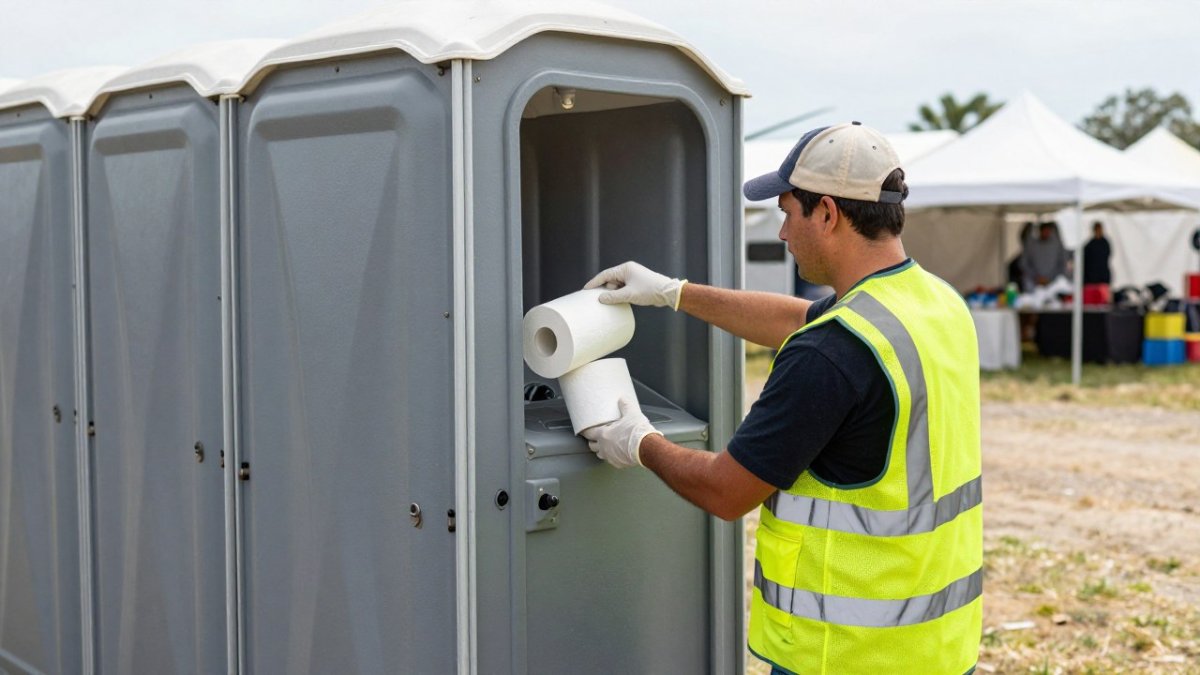
Pre-Event Setup and Day One
Setup happens before gates open, and the clock matters more than the checklist. A workable sequence:
- T-minus 48 to 24 hours: Deliver and place units, confirm service-truck access lanes, and stage supply caches at each zone. Walk every route with the driver so no one discovers a blocked path at 2 a.m.
- T-minus 12 hours: Stock every unit fully, test door latches and locks, confirm handwashing station water and soap, and tag each unit with its ID.
- T-minus 2 hours: Final walk-through. Check that accessible units are unobstructed, ramps are clear, and lighting works for evening access.
Day one is your calibration day. The data you record, fill rate per zone, supply burn rate, queue length at peak, shapes every later day. Adjust crew assignments for day two before the overnight crew leaves the site.
Peak Days, Overnight Servicing, and Tear-Down
Peak days run on overlapping shifts rather than a single long one. A common pattern:
- Early morning (roughly 5 a.m. to 8 a.m.): Overnight crew finishes deep cleaning and pumping; day crew arrives for handoff. Review the overnight log and reassign units that failed inspection.
- Mid-morning to early afternoon: Routine service pass across all zones. Restock, wipe high-touch surfaces, and check accessible units.
- Afternoon peak (roughly 2 p.m. to 8 p.m.): Mid-event service in stage-adjacent and food-zone clusters every four to six hours, or sooner if triggers fire. Keep a roving crew free for queue management and spill response.
Watch out: overnight servicing is the first task skipped when crews are tired, and a single missed overnight pass typically shows up as a failure two days later when the crowd is largest.
Tear-down is its own schedule, not an afterthought:
- Final event hour: Last mid-event pass and supply top-off so attendees leave without encountering a failed unit.
- Post-gates: Pump every tank, clean and disinfect every unit, remove all waste and trash, and stage units for pickup.
- Final walk-through: A second person walks the site with the checklist. Most missed problems, a unit left unlocked, a spill behind a cluster, a damaged door, surface here rather than on the crew's own inspection.
Repeat the peak-day template for each remaining event day, adjusting service windows based on the previous day's log. The schedule should tighten, not loosen, as the event progresses and units accumulate wear.
The Portable Restroom Cleaning Checklist Every Crew Should Carry
Every service visit follows the same steps. A written checklist keeps crews consistent, especially when they split across zones.
Here is the short version we would hand a crew:
- Pump the waste tank
- Scrub the bowl and urinal area
- Wipe high-touch surfaces: door handle, latch, seat
For a full version organizers can hand to a crew, our portable toilet cleaning checklist for event organizers covers each step in detail.
What Belongs in a Portable Restroom Supplies Checklist
Supplies run out faster than most organizers expect. A festival with food vendors and evening entertainment burns through toilet paper and sanitizer at a rate that surprises first-time planners.
Stock these on every service truck:
- Toilet paper, at least two spare rolls per unit
- Hand sanitizer, refill bottles plus spare dispensers
- Soap for handwashing stations
Running out of supplies mid-event is worse than a dirty unit. People forgive a messy floor. They do not forgive no toilet paper at 9 p.m.
For broader guidance on keeping hygiene standards high across a public event, see our guide on managing portable toilet hygiene at public events.
Building a Portable Restroom Inspection Log That Actually Gets Used
An inspection log only works if it takes seconds to fill out. Long forms get skipped. Short ones get done.
Keep each entry to five fields:
| Field | What to Record |
|---|---|
| Time | When the service happened |
| Unit ID | Which unit was serviced |
| Service type | Daily, mid-event, or overnight |
| Issues found | Damage, low supplies, odor |
| Crew initials | Who did the work |
That is it. Five fields, one line per unit.
The log does two things. It proves service happened when a vendor or health inspector asks. And it shows patterns, like a unit that keeps running out of supplies or a zone that always needs extra service.
Review the log each morning. Adjust the day's schedule based on what it shows.
Staffing, Routing, and Contingencies for Weather, Spills, and Accessible Units
Staffing and routing decide whether your schedule survives contact with a real crowd. Most festival sanitation plans fail not because the frequency was wrong but because the crew could not reach the unit, ran out of supplies mid-route, or had no escalation path when a tank overflowed. This section turns the schedule into a crew plan, a route checklist, and a set of contingency procedures.
Crew Plan and Shift Structure
A simple starting rule is one service crew per 20 to 30 units, split by zone so no one walks the whole site between services. For a multi-day event, structure shifts around the service windows rather than around an eight-hour clock:
- Day crew: routine service passes, restocking, accessible-unit checks, and queue monitoring.
- Mid-event crew: roving, assigned to the highest-traffic zones during peak hours, with authority to service early when a trigger fires.
- Overnight crew: deep cleaning, full pump-out, damage inspection, and log review.
Assign one crew member per shift to monitor accessible units specifically. Those units see more users per unit than standard restrooms and fail faster when they do.
Route Checklist
Route planning matters more than most organizers realize. Blocked routes turn a 30-minute service window into two hours. Before gates open, confirm:
- A mapped service route to every unit cluster, walked by the driver.
- A clear lane wide enough for the service truck at every cluster, with no vendor tents or staging encroaching.
- Supply caches positioned so crews reload between service windows rather than mid-route.
Weather and Site-Condition Contingencies
Rain, heat, mud, and access restrictions change both cleaning needs and service routes. Practical adjustments:
- Heat: supply burn and odor rise faster; shorten the interval between mid-event passes and increase sanitizer restocking.
- Rain and mud: routes that were passable at setup may not be after a storm; identify alternate access before the event and keep mats or gravel on hand for high-traffic paths.
- High wind: unsecured units can tip; confirm anchoring before the event and recheck after any wind event. For step-by-step guidance on securing units before a storm, our guide on how to secure portable toilets during high winds walks through the process.
Spill, Overflow, and Emergency Response
Clear escalation steps address the operational risks that high-level planning advice often omits:
- Isolate: block the affected unit or area and redirect attendees to the nearest alternative.
- Contain: absorb and bag spill material; do not hose it into the site.
- Clean and disinfect: treat the area and the unit before returning it to service.
- Stage a spare: keep at least one spare unit per major zone so a failed unit can be swapped rather than left out of service.
- Log and escalate: record the incident, notify the event operations lead, and flag the unit for inspection at the next service window.
Watch out: a missed service or a vandalized unit left in place is worse than a dirty unit, because attendees route around it and the mess lands somewhere else on your site.
Accessible-Unit Maintenance
Accessible units need to stay unobstructed, stocked, clean, and reachable throughout the event, not just provided in the right count. On every service visit, check the ramp, handrails, door width, and interior clearances; confirm the path to the unit is free of vendor equipment and standing water; and verify supplies are stocked at the same level as standard units.
For planning efficient routes across a large site, see our portable toilet placement strategies for large fields.
Planning Your Festival Restroom Schedule with Patriot Solutions
A portable restroom maintenance schedule for multi-day festivals comes down to three things: a clear baseline, a crew that follows the checklist, and a plan for when things go wrong. Get those right and the restroom line stays short all weekend.
Patriot Solutions provides portable restrooms and roll-off dumpsters in the Delta, Utah area, with clean equipment and dependable local service.
Whether you are planning a small backyard wedding or a multi-day festival, the right service plan depends on your attendance and event dates. Contact Patriot Solutions directly for current prices and a quote.
Building a festival schedule is easier when your sanitation provider shows up on time, every time.
Frequently Asked Questions
How often should portable restrooms be serviced during a multi-day festival?
Most multi-day festivals need at least one full service per unit per day, with a second pass during peak attendance days. High-traffic zones near stages and food service areas often need servicing twice daily. Waste tanks should be pumped before they reach capacity, and supplies restocked at every visit. Crowd size, event hours, and heat all push the frequency up, so build the schedule around attendee count rather than a fixed number.
What should a portable restroom cleaning checklist include?
A workable portable restroom cleaning checklist covers tank level and pumping, bowl and seat disinfection, floor and wall wipe-down, odor control, toilet paper and soap restocking, hand sanitizer refills, door latch and lock checks, and safe lighting verification. Add a signature and timestamp line so supervisors can confirm each unit was actually serviced. Crews should note any damage or blockages for follow-up rather than skipping past them.
What supplies should be restocked in festival restrooms?
The core portable restroom supplies checklist includes toilet paper, hand soap, hand sanitizer, paper towels, and deodorizer or odor control treatment. Handwashing stations need fresh water and soap refills. Keep a buffer of at least 20 percent extra stock on site so a busy afternoon does not leave units empty before the next service run. Accessible units should be checked for grab bar condition and clear interior space at the same time.
Who should monitor portable restrooms during a festival?
Assign a dedicated sanitation lead who owns the service route, the inspection log, and communication with the provider. That person coordinates with event staff stationed near high-use areas, who report full tanks, empty supplies, or spills as they happen. A written log with timestamps turns those reports into a record you can act on. For larger festivals, split monitoring by zone so no area goes unchecked between scheduled service visits.