 ultimate-guide
Portable Sanitation for Seasonal Farm Crews
Table of Contents
- OSHA Field Sanitation Standards Every Farm Manager Should Know
- How Many Porta Potties Per Worker Do You Actually Need?
- Portable Restroom Service Frequency for Agricultural Crews
- Types of Portable Sanitation Units for Farm Operations
- Placement and Accessibility in Fields and Orchards
- Leasing vs. Owning: Cost-Benefit Analysis for Portable Sanitation
- Waste Disposal, Environmental Impact, and Farm Safety Training
- Frequently Asked Questions
Last Updated: September 16, 2026
OSHA Field Sanitation Standards Every Farm Manager Should Know
Portable sanitation for seasonal farm crews is not optional. Under the OSHA field sanitation standard (29 CFR 1928.110), agricultural employers with 11 or more hand-laborers must provide toilets, potable drinking water, and handwashing facilities at the worksite. This guide from Patriot Solutions breaks down what that means in practice.
Handwashing and Potable Water Requirements
OSHA requires both handwashing water and drinking water onsite. They are not interchangeable, and mixing them up is a common citation.
The requirements, in plain terms:
- One handwashing facility per 20 employees, or one per crew of 20 or fewer
- Potable drinking water, dispensed so workers can drink without touching a shared cup
- Soap and single-use towels at each handwashing station
- Water coolers or dispensers refilled as needed during the shift
- All facilities within a quarter-mile walk of the workers' location
GAP Certification and Compliance Documentation
GAP certification (Good Agricultural Practices) audits go beyond OSHA. Auditors want proof, not just equipment on site.
What auditors typically ask for:
- A written sanitation plan covering toilets, water, and handwashing
- Service records showing scheduled pump-outs and fresh water refills
- Documentation that workers received sanitation training
- Bilingual signage at each facility
- A log of any maintenance or repair issues
How Many Porta Potties Per Worker Do You Actually Need?
The standard answer is one portable toilet per 20 workers, but field logistics change the math. How many porta potties per worker depends on crew size, distance to facilities, and shift length.
For planning purposes, use this baseline:
| Crew Size | Minimum Units | Practical Setup |
|---|---|---|
| 1-20 workers | 1 toilet + 1 handwash station | Single trailer-mounted unit |
| 21-40 workers | 2 toilets + 1 handwash station | Two units, split across field zones |
| 41-60 workers | 3 toilets + 2 handwash stations | Three units, one per work zone |
| 61-80 workers | 4 toilets + 2 handwash stations | Four units plus a dedicated water trailer |
Scaling Unit Counts for Peak Harvest Crews
Harvest crews are not constant. A farm might run 15 workers in June and 70 in September. That swing is the reason flexible rental agreements exist.
Plan for three numbers:
- Base crew, the smallest headcount you run most of the season
- Peak crew, the largest number during harvest
- Transition weeks, the two weeks on either side of peak
Portable Restroom Service Frequency for Agricultural Crews
Portable restroom service frequency depends on how many workers use each unit and how hot the weather is. The general rule: one pump-out per week per unit for crews under 20, twice weekly once a crew passes 40.
Types of Portable Sanitation Units for Farm Operations
Not every unit fits every job. Farm operations typically need three types, and many crews use all three at once.
Placement and Accessibility in Fields and Orchards
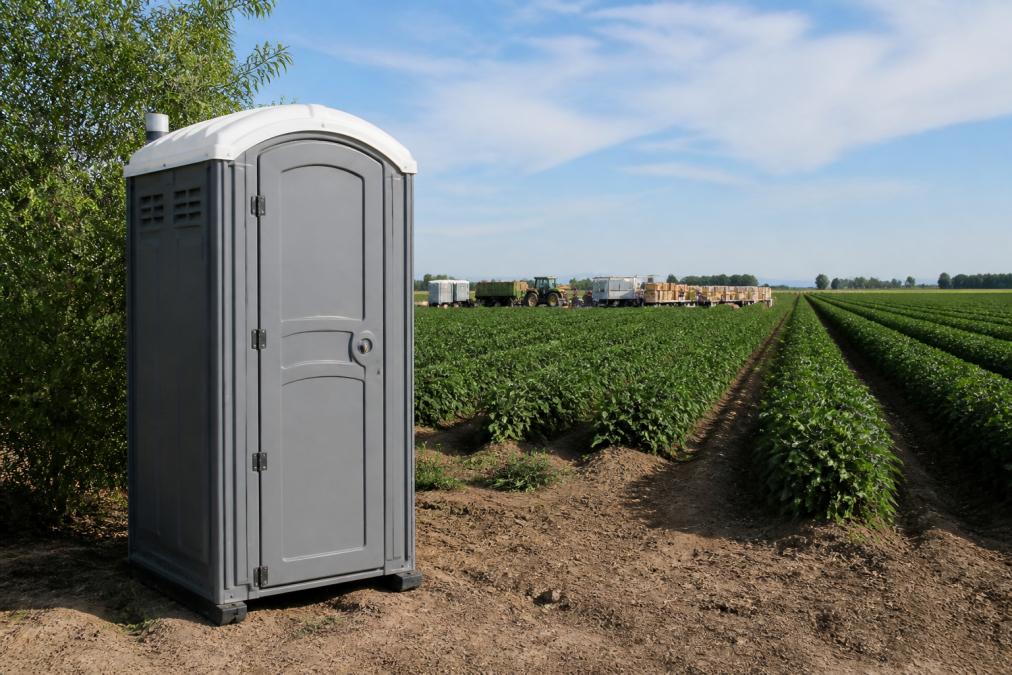
Placement is where most sanitation plans fail. The rule: every worker must reach a facility within a quarter-mile walk during the shift.

Practical placement guidelines:
- Set units on level ground with a clear path, not in mud or tall grass
- Position away from irrigation lines and drainage
- Keep units visible from the main work area so workers know where they are
- Anchor units against wind, especially in open fields
- Provide a clear route for the service truck to reach each unit
ADA-Compliant Options and Bilingual Signage
ADA-accessible units are not required for every farm crew, but they are required when a worker or visitor with a disability needs access. The ADA Standards for Accessible Design set the dimensions for door width, interior turning space, and grab bar placement.
Leasing vs. Owning: Cost-Benefit Analysis for Portable Sanitation
Owning portable toilets sounds cheaper until you add up the hidden costs. Leasing wins for most seasonal operations, but the math depends on how many weeks per year you actually need units.
The Real Cost Stack on Each Side
Owning carries costs that do not show up on the purchase invoice:
- Purchase price per unit (standard units run in the low hundreds to low thousands of dollars; trailer-mounted multi-stall units cost substantially more)
- Pump-out and fresh-water service, you still pay a hauler, often at a per-service rate similar to a rental service call
- Off-season storage, indoor or covered space, or you accept UV and freeze damage
- Maintenance and repairs, doors, hinges, tanks, vents, and the pump-out valve all wear
- Transport between fields, you need a truck and driver every time units move
- Compliance risk, a unit sitting unused and unserviced can fail inspection the day you need it
Leasing bundles most of that into one line:
- Rental fee per unit per service period
- Delivery and pickup
- Service calls, included or billed per visit
- No storage, maintenance, or transport burden on your side
The Break-Even Logic
Farm managers often compare annual lease cost against purchase price plus one year of service and stop there. That comparison is misleading, it ignores resale value, storage cost, and the service cost you pay either way.
A more honest framework:
- Estimate your total service weeks per year (weeks units are actually deployed).
- Multiply by the number of units you need at peak.
- Compare annual lease cost against: purchase price ÷ expected service life (in years) + annual service cost + annual storage cost + annual maintenance reserve.
Why Flexible Rental Agreements Usually Decide It
Even when the raw math favors owning, operational risk usually tips the decision back to leasing. A flexible rental agreement lets you:
-
Run a base number of units during the regular season
-
Add trailer-mounted units for peak harvest weeks
-
Scale back down after peak without paying for empty toilets
-
Swap a failed unit for a working one the same week
-
What is the lead time to add units mid-season?
-
Is there a minimum service period, or can units be added and removed week by week?
-
What happens if a unit fails during harvest, how fast is the replacement?
When Owning Makes Sense
Owning is not wrong, just narrower than most articles admit. It tends to make sense when:
- Units are deployed most of the year, not just at harvest
- The farm has secure, covered storage already
- The farm has its own truck and driver for transport
- The farm has a service relationship that treats owned units the same as rented ones
Waste Disposal, Environmental Impact, and Farm Safety Training
Where the waste goes matters more than most farm managers realize. Portable toilet waste is classified as domestic septage and cannot be land-applied, buried, or dumped on your own property. It must be pumped by a licensed hauler and taken to a permitted receiving facility, typically a municipal wastewater treatment plant or a state-permitted septage treatment site.
What Legal Disposal Actually Looks Like
The chain has four steps, and you should be able to trace every one:
- Pump-out, A vacuum truck removes the waste from the unit and holding tank.
- Transport, The hauler carries it in a permitted vehicle, with manifest paperwork.
- Receiving facility, The waste is discharged at a permitted treatment plant or septage receiving station.
- Treatment and discharge, The facility treats the waste to its permit limits before releasing treated water.
Ask your provider three questions before signing:
- Which treatment facility receives your waste, and what is its permit number?
- Can you provide a disposal manifest or service ticket showing the receiving site?
- What is your spill response plan if a pump-out line fails in the field?
Why This Matters Near Wells, Streams, and Irrigation
Septic waste carries pathogens, E. coli, Salmonella, and other enteric organisms, plus nitrogen and phosphorus. If a unit is pumped improperly or a spill happens near a wellhead, stream, or irrigation intake, the contamination pathway is direct: a food-safety, drinking-water, and public-relations problem at once.
Practical safeguards:
- Keep units at least 50 feet from any wellhead, stream, ditch, or irrigation source where local rules allow; check state setback requirements, which are often stricter.
- Never place a unit on a slope where a spill would run toward a water source.
- Require the hauler to carry spill kits and absorbent material on the truck.
- Photograph the unit and surrounding ground after every pump-out, and keep the images with your service records.
Integrating Sanitation Into Farm Safety Training
A practical first-day module covers five points:
- Location, Walk the crew to each unit and handwash station so no one is guessing.
- Use, Demonstrate proper handwashing: soap, scrub, rinse, single-use towel.
- Reporting, Show workers how to flag a unit that needs service, and who to tell.
- Rules, Handwashing before eating, drinking, smoking, or returning to the pack line.
- Documentation, Sign the training roster. GAP auditors want proof the training happened, not just a claim.
When sanitation is treated as part of safety culture rather than a piece of equipment, compliance takes care of itself: units get serviced on schedule, signs stay posted, and paperwork is ready before anyone asks.
Frequently Asked Questions
What are the OSHA requirements for portable toilets on farms?
OSHA field sanitation standards require farms with 11 or more agricultural workers to provide at least one toilet and one handwashing station per 20 workers. Potable drinking water must also be available within a quarter-mile walk of where crews are working. Units must be maintained in clean, sanitary condition and serviced regularly. Farms with fewer than 11 workers are exempt from the toilet requirement but still must provide potable water.
How many portable toilets are required per number of farm workers?
The general rule is one toilet per 20 workers, with separate facilities or additional units when both men and women are on the crew. For a 60-person harvest crew, plan on at least three units. During peak harvest when crews swell, add units rather than stretching the existing count. A quick site assessment with your portable sanitation provider can confirm the right number based on crew size, shift length, and field layout.
How often should portable toilets be serviced for agricultural crews?
Portable restroom service frequency depends on factors like crew size, usage, and weather conditions. More frequent pump-out service prevents odor and keeps units sanitary, especially in hot weather or with high usage.
What is the best placement for portable restrooms in agricultural fields?
Place units at the field edge or along a central access path so workers can reach them within a quarter-mile walk, as OSHA field sanitation standards require for water access. Keep them downwind of work areas and away from irrigation lines. For large fields, use trailer-mounted units that can be relocated as the harvest moves. Bilingual signage helps seasonal labor crews find units quickly and confirms compliance during GAP certification audits.
Running a farm crew through harvest is hard enough without a sanitation gap in the middle of it. Patriot Solutions provides portable restrooms, handwashing stations, and roll-off dumpsters for farm operations, with clean equipment, fast delivery, and dependable local service. If you need units that scale with your crew count and a service schedule you can actually rely on, Patriot Solutions can help. Get started with Patriot Solutions and keep your crew compliant from first pick to last.