 how-to
How Much Does a Cubic Yard of Concrete Weigh?
Last Updated: October 26, 2026
Quick Summary
The average concrete weight is about 4,000 pounds per cubic yard, with most standard concrete falling between 3,600 and 4,050 pounds. Fresh concrete runs heavier at roughly 3,900 to 4,150 pounds per cubic yard, while broken concrete weighs only about 2,000 to 2,600 pounds per cubic yard.
- Standard concrete density is about 150 pounds per cubic foot, which equals roughly 4,050 pounds per cubic yard.
- Cured concrete often weighs 100 to 300 pounds less per cubic yard than the same mix did when placed.
- Lightweight concrete typically runs 2,000 to 3,000 pounds per cubic yard depending on the mix.
- You need 45 bags of 80-pound concrete mix to make one cubic yard.
- Reinforced concrete adds 100 to 250 pounds per yard for typical rebar layouts.
Table of Contents
- The Average Weight of Concrete Per Cubic Yard
- Wet vs. Dry Concrete Weight: What Changes After the Pour
- Concrete Density, Pounds Per Cubic Foot, and Unit Conversions
- Using a Concrete Slab Weight Calculator
- Lightweight Concrete Weight Per Cubic Yard
- How Many Bags of Concrete in a Cubic Yard?
- Reinforced Concrete Weight Per Cubic Yard
- Planning Your Dumpster Size Around Concrete Load Weight
- Frequently Asked Questions
The Average Weight of Concrete Per Cubic Yard
The average weight of concrete per cubic yard is about 4,000 pounds, with most estimates between 3,600 and 4,050 pounds for standard concrete. That number drives truck limits, dumpster sizing, and disposal costs on every job.
But the number is not fixed. It moves with mix design, moisture, and reinforcement.
Why the Number Isn't a Single Figure
Weight depends on what goes into the mix and how wet it is when you weigh it. A published guide on concrete weight puts regular concrete at roughly 3,600 to 4,050 pounds per cubic yard. The spread is real, not rounding error.
Four things move the number:
- Aggregate type. Dense stone weighs more than lighter gravel or crushed material.
- Water content. Wet concrete is heavier than cured concrete.
- Cement ratio. Richer mixes carry more material per yard.
So treat 4,000 pounds as a working figure, not a guarantee.
Wet vs. Dry Concrete Weight: What Changes After the Pour
Wet concrete weighs more than cured concrete because it still holds mix water. As that water leaves during curing, the slab gets lighter, a modest drop that matters near a load limit.
Here is the practical split:
- Freshly placed concrete: heaviest, because water is still present.
- Cured concrete: lighter by the amount of water that evaporated.
- Broken concrete: lighter again per yard, because voids form between chunks.
That last point trips people up. Crushed concrete is not the same density as a solid slab. A gravel supplier's material guide reports crushed concrete at roughly 2,000 to 2,600 pounds per cubic yard.
How Much Water Leaves, and Why It Matters
Most of the weight difference comes from water added for workability that never becomes part of the hardened binder.
Cement hydrates and locks water into solid compounds, but water beyond what hydration needs remains as free moisture in the pore structure, migrating to the surface, evaporating, or draining away, leaving a lighter, more porous solid than the wet mix you started with.
Fresh, Hardened, and Dry: Three Different Numbers
Load planning gets easier when you separate three states:
| State | What it means | Typical weight per cubic yard |
|---|---|---|
| Fresh (wet) | Just placed, full mix water present | About 3,900 to 4,150 lb |
| Hardened (cured) | Hydrated and set, some moisture lost | About 3,600 to 4,050 lb |
| Dry (oven-dry) | Laboratory condition, essentially no free water | About 3,400 to 3,900 lb |
Those ranges are planning bands, not precise predictions. A mix with a high water-to-cement ratio, lightweight aggregate, or air entrainment will sit lower; a dense, low-slump mix with heavy stone will sit higher.
Why the Drop Is Bigger Than It Looks on a Small Pour
On a single slab, 200 pounds per cubic yard sounds minor. Scale it up: a 10-cubic-yard tear-out that weighs 40,000 pounds fresh may weigh closer to 38,000 pounds once cured and broken, a full short ton, enough to push a container past its rated limit.
The reverse mistake is also common: contractors estimate broken concrete at solid-slab density, then wonder why the container fills before it hits the weight limit. Broken concrete has voids between chunks, so plan volume on the broken figure and weight on the solid figure.
What This Means for Your Estimate
Use the wet weight when ordering ready-mix, the cured weight for dried demolition loads, and the broken weight when sizing a dumpster by volume. If the load is close to a limit, weigh a sample or ask the supplier for the mix's fresh density.
Concrete Density, Pounds Per Cubic Foot, and Unit Conversions
Concrete density is the weight of a set volume of material, usually stated as pounds per cubic foot. Standard concrete runs about 150 pounds per cubic foot. Multiply by 27 cubic feet per cubic yard and you get roughly 4,050 pounds per yard.
That is the whole calculation. Density times volume equals weight.
Cubic Feet to Cubic Yards and Pounds to Kilograms
Use these conversions to move between units without guessing:
| Conversion | Formula | Example |
|---|---|---|
| Cubic feet to cubic yards | Divide by 27 | 54 cu ft ÷ 27 = 2 cu yd |
| Cubic yards to cubic feet | Multiply by 27 | 2 cu yd × 27 = 54 cu ft |
| Pounds to short tons | Divide by 2,000 | 4,000 lb ÷ 2,000 = 2 tons |
| Pounds to kilograms | Multiply by 0.4536 | 4,000 lb × 0.4536 = 1,814 kg |
| Kilograms per cubic meter | Multiply lb/cu yd by 0.5933 | 4,000 × 0.5933 = 2,373 kg/m³ |
A cubic yard of standard concrete is about 2 short tons. Keep that in your head and most load math gets easy.
Using a Concrete Slab Weight Calculator
A concrete slab weight calculator multiplies slab volume by concrete density to give total weight.
Worked example for a 10 ft × 10 ft slab at 4 inches thick:
- 4 inches = 0.333 ft
- 10 × 10 × 0.333 = 33.3 cubic feet
- 33.3 × 150 = about 5,000 pounds
That is 2.5 short tons from a small patio slab. Scale that to a driveway and the hauling problem becomes obvious.
Watch out: calculators assume standard density. If your concrete is lightweight or heavily reinforced, the output will run high or low. Adjust the density input when the tool allows it.
Lightweight Concrete Weight Per Cubic Yard
Lightweight concrete weight per cubic yard runs well below standard concrete, often 2,000 to 3,000 pounds depending on the mix.
Why pay more for less weight? Structural load. Lightweight mixes reduce dead load on floors and decks, letting engineers slim down supporting members.
For disposal planning, lightweight concrete is good news. Fewer pounds per yard means more yards per dumpster load.
How Aggregate Type Drives Density
Concrete weight is mostly aggregate weight. The paste, cement, water, and admixtures, makes up roughly a quarter to a third of the volume, and aggregate fills the rest, so changing the aggregate changes density more than any other single decision.
Most practitioners group concrete into three density classes based on the aggregate:
| Class | Aggregate type | Typical weight per cubic yard |
|---|---|---|
| Lightweight | Expanded shale, clay, slate, or slag; pumice; scoria | About 2,000 to 3,000 lb |
| Normal-weight | Crushed limestone, granite, gravel, trap rock | About 3,600 to 4,050 lb |
| Heavyweight | Barite, magnetite, hematite, steel punchings | About 5,000 to 8,000 lb and up |
Those bands are planning ranges, not guarantees. A structural lightweight mix designed for a floor system often lands near 2,400 to 2,800 pounds per cubic yard, while an insulating lightweight mix with very porous aggregate can run closer to 2,000.
What Changes Inside the Mix
Lightweight aggregate is porous, which makes it light and changes how the mix behaves. It absorbs water, so producers often pre-soak it or adjust water content to keep the mix workable.
Air entrainment is another lever: it improves freeze-thaw durability and drops density slightly, typically by a few percent. It is common in exterior flatwork in cold climates and is one reason two mixes of the same aggregate can weigh different amounts.
Planning Loads Around Lightweight Concrete
The weight difference is large enough to change how you plan a tear-out. A 20-yard container rated for 20,000 pounds holds roughly 5 cubic yards of normal-weight broken concrete at 4,000 pounds per yard, but closer to 8 cubic yards of lightweight debris at 2,500 pounds per yard, a meaningful difference in trips.
When Lightweight Concrete Shows Up in Disposal
Lightweight concrete appears in high-rise floor systems, bridge decks, precast panels, and some fire-rated assemblies. If you are tearing out a commercial floor or precast element, ask the owner or supplier for the mix design. The density difference can be 1,000 pounds per cubic yard or more, the difference between one container and two.
For a typical residential slab, assume normal-weight concrete. For anything structural or commercial, confirm the mix before you estimate the load.
How Many Bags of Concrete in a Cubic Yard?
You need 45 bags of 80-pound concrete mix to make one cubic yard, or 60 bags of 60-pound mix, or 90 bags of 40-pound mix.
| Bag Size | Bags per Cubic Yard | Bags per Cubic Foot |
|---|---|---|
| 80 lb | 45 | About 1.7 |
| 60 lb | 60 | About 2.2 |
| 50 lb | 72 | About 2.7 |
| 40 lb | 90 | About 3.3 |
Most bags yield about 0.6 cubic feet per 80 pounds. Check the yield printed on the bag, since brands vary slightly.
For small pours, bags make sense. If you are estimating a larger cleanup, our guide on estimating construction waste volume walks through the volume math.
Reinforced Concrete Weight Per Cubic Yard
Reinforced concrete weight per cubic yard runs heavier than plain concrete, typically adding 100 to 250 pounds per yard for typical rebar layouts. The concrete itself does not change.
Rough steel weights to plan around:
- #4 bar at 12-inch spacing: modest addition, roughly 1 to 2 percent of total weight
- #5 or #6 bar at close spacing: heavier, and worth adding to your estimate
- Mesh reinforcement: light, often negligible for load planning
The exact figure depends on bar size, spacing, and layers.
A common mistake is estimating reinforced debris at plain concrete density. The load comes in heavier and the container fills faster than planned.
Planning Your Dumpster Size Around Concrete Load Weight
Size the dumpster by weight first, volume second. For roll-off dumpsters sized for concrete and cleanup work in Delta and Central Utah, see roll-off dumpsters in Delta, Utah.
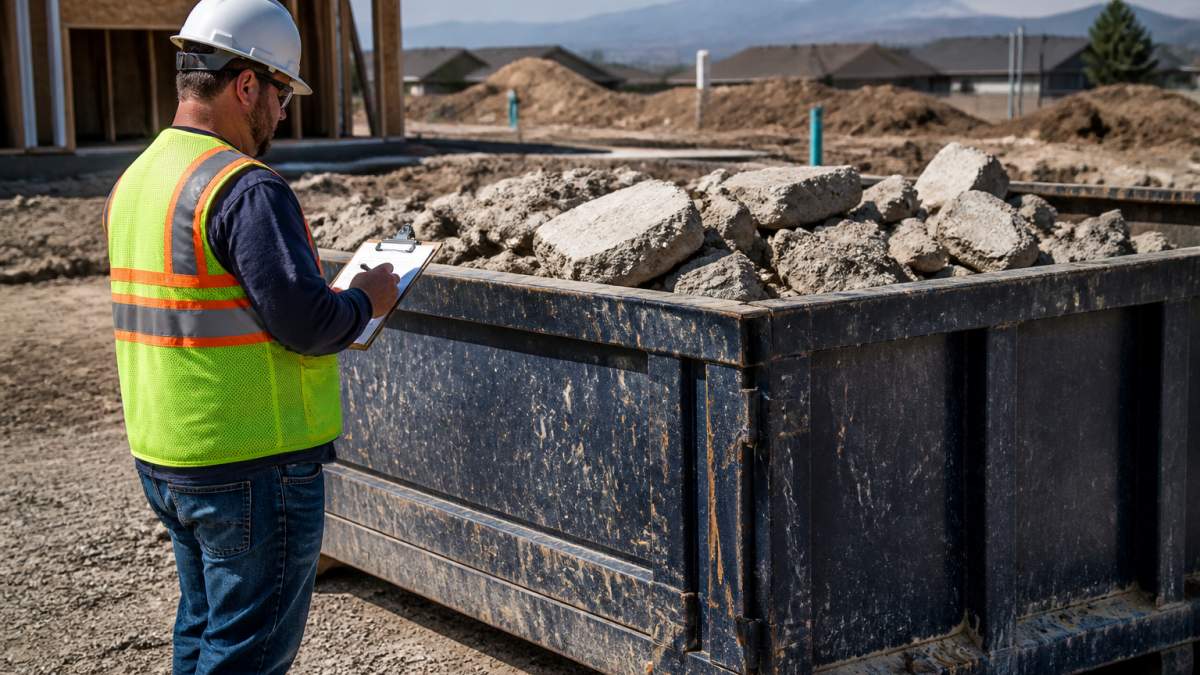
Run the numbers before you call:
- Measure the slab in cubic yards.
- Multiply by 4,000 pounds for solid concrete, or 2,400 pounds for broken.
- Divide total pounds by 2,000 to get short tons. Before booking, you can review roll off dumpster rental pricing to anticipate the cost.
- Compare that tonnage to the container's rated weight limit.
Then plan the work itself. Our guide on breaking up concrete for disposal covers tools, cut lines, and safe demolition sequence. Once the debris is down, how to dispose of concrete debris in a roll-off dumpster explains what goes in the can and what stays out.
Heavy loads also mean hauling rules. Overweight containers can be refused at the scale, and the cleanup lands on you.
Concrete weight math is simple until a load comes in heavy and the container gets flagged.
Frequently Asked Questions
How much does a cubic yard of regular concrete weigh?
A cubic yard of regular, normal-weight concrete typically lands near 4,000 pounds, with published guides giving a range of roughly 3,600 to 4,050 pounds. That works out to about 150 pounds per cubic foot, or 2.025 short tons per cubic yard. The exact concrete weight depends on the mix design, how much water was added, and whether the material is solid or broken up. A cured slab sits at the high end; rubble from a demolition sits closer to 2,000 to 2,600 pounds.
How do I calculate the weight of a concrete slab?
Multiply length by width by thickness in feet to get cubic feet, divide by 27 to convert to cubic yards, then multiply by the unit weight. For normal-weight concrete, use about 150 pounds per cubic foot. A 10-foot by 10-foot slab at 4 inches thick is 33.3 cubic feet, or 1.23 cubic yards, which comes out near 5,000 pounds. A concrete slab weight calculator does the same math, but check that it lets you pick solid versus broken concrete.
Does reinforced concrete weigh more than regular concrete?
Yes, but usually not by as much as people expect. Steel rebar adds weight on top of the concrete weight per cubic yard, and the amount depends on bar size and spacing. A lightly reinforced slab may add only a small percentage; heavily reinforced sections add more. For dumpster planning, treat reinforcement as a modest upward adjustment and confirm the actual tonnage with your supplier or contractor rather than guessing.
How many 40-pound bags of concrete make a cubic yard?
A 40-pound bag yields about 0.30 cubic feet, and a cubic yard holds 27 cubic feet, so you need roughly 90 bags to fill one cubic yard. An 80-pound bag yields about 0.60 cubic feet, so about 45 bags do the same job. Bag counts matter for small pours and patch work, not for demolition debris. If you are tearing out concrete instead of placing it, plan dumpster capacity by weight, not by bag count.