 how-to
Tips for Loading Construction Dumpsters Efficiently
Table of Contents
- Why Efficient Loading Matters: Cost, Safety, and Schedule
- Roll-Off Dumpster Weight Limits: What You Need to Know Before You Load
- What Can You Put in a Construction Dumpster? (And What's Prohibited)
- How to Break Down Large Debris for Disposal: Dismantle, Flatten, and Stack
- 10 Tips for Loading Construction Dumpsters Efficiently
- Safety Precautions and Seasonal Loading Tips for Every Project
- Conclusion: Load Smarter, Not Harder
- Frequently Asked Questions
Last Updated: September 24, 2026
Why Efficient Loading Matters: Cost, Safety, and Schedule
Loading a construction dumpster well is the difference between one clean pickup and a week of headaches. For tips on loading construction dumpsters efficiently, the stakes come down to three things: money, safety, and your timeline. A poorly packed roll-off dumpster wastes volume you already paid for. It also raises the risk of an overweight container that cannot legally leave your site.
The Real Cost of an Overloaded or Underfilled Dumpster
A few minutes of planning before the first shovel load saves hours later.
Roll-Off Dumpster Weight Limits: What You Need to Know Before You Load
Every roll-off dumpster has two limits: volume and weight. Volume is easy to see. Weight is not, and that is where most crews get caught. A dumpster can look half full and still be over its load limit if you filled it with dense material.
Heavy debris adds up fast:
- Concrete, brick, and asphalt weigh the most per cubic foot
- Dirt and gravel are heavy and compact tightly
- Wood and drywall are lighter by volume
- Cardboard and packaging take space but add little weight
How to Estimate Debris Weight Without a Scale
- Concrete, brick, and asphalt: roughly 3,000 to 4,000 pounds per cubic yard
- Dirt and gravel: roughly 2,000 to 3,000 pounds per cubic yard
- Roofing shingles: roughly 2,000 to 2,500 pounds per cubic yard
- Wood framing and pallets: roughly 300 to 500 pounds per cubic yard
- Drywall: roughly 500 to 800 pounds per cubic yard
- Cardboard, flattened: roughly 50 to 100 pounds per cubic yard
| Material | Approx. weight (per cubic yard) | Loading tip |
|---|---|---|
| Concrete, brick, asphalt | 3,000-4,000 lb | Bottom layer only; consider a heavy-debris container |
| Dirt, gravel | 2,000-3,000 lb | Spread thin, never pile in one corner |
| Roofing shingles | 2,000-2,500 lb | Keep to lower half; do not top off with shingles |
| Wood, drywall | 300-800 lb | Middle and top layers |
| Cardboard, packaging | 50-100 lb | Flatten and stack to save volume |
When in doubt, keep heavy material to the lower third of the container and call your hauler before you fill it. Ask two questions: what is my included tonnage, and what is the per-ton overage fee? For exact tonnage limits on your rental, get the answer in writing before the container lands on your site.
What Can You Put in a Construction Dumpster? (And What's Prohibited)
Most construction debris is fine: wood, drywall, roofing, framing, and packaging. The problems come from items that are banned at the landfill. Putting a prohibited item in your dumpster can get the whole load rejected and returned to your site, and you pay for the trip.
Common prohibited items include:
- Paint, solvents, and other liquids
- Tires and batteries
- Asbestos and lead-based material
- Appliances with refrigerant
- Any hazardous waste
Hazardous Waste and Landfill Regulations You Must Follow
Hazardous waste cannot go in a standard construction dumpster. Federal rules under the EPA hazardous waste regulations set strict handling and disposal requirements. Your state and county landfill rules add their own limits on top of that. When you are unsure about an item, ask before you toss it. A single banned item can turn a cheap load into an expensive problem.
How to Break Down Large Debris for Disposal: Dismantle, Flatten, and Stack
Breaking down large debris for disposal is the single biggest space saver. A couch, a pallet, or a cabinet takes far less room once it is dismantled and flattened. This step alone can cut how many containers your project needs.
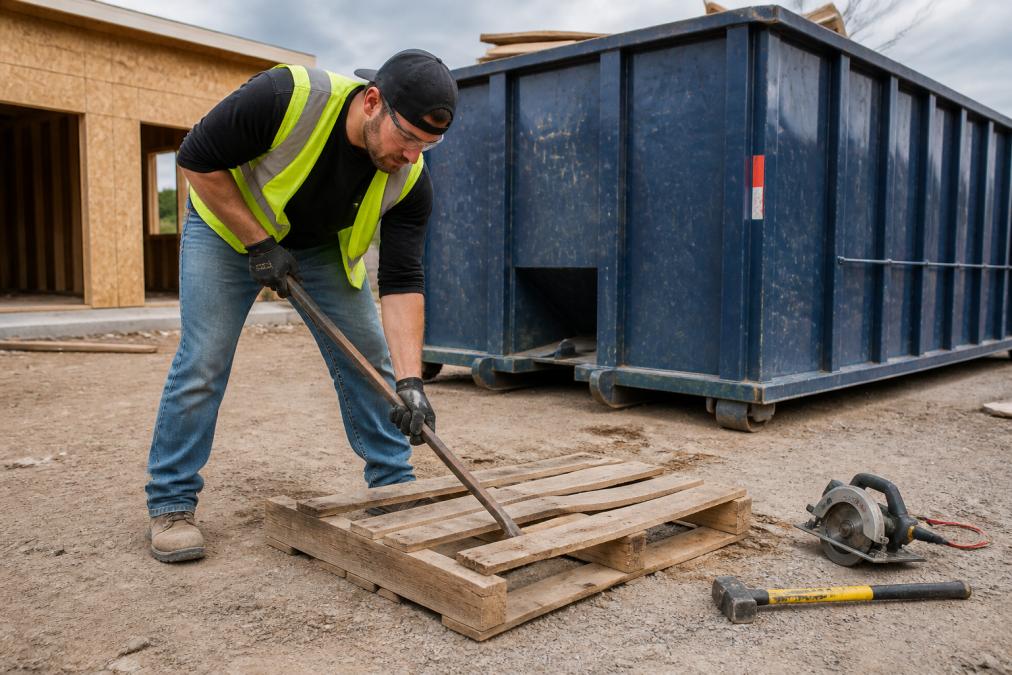
Start with the bulkiest items:
- Dismantle furniture and cabinets into flat panels
- Flatten cardboard boxes before stacking
- Break long boards and trim to fit the container width
- Stack flat material in tight, even layers
Tools That Make Breaking Down Debris Faster and Safer
- Pry bar or crowbar. The workhorse for pallets, nailed framing, and cabinets. A 24- to 36-inch bar gives you enough leverage to pop nailed joints without wrecking the wood.
- Reciprocating saw. Faster than a circular saw for cutting through nailed-together framing, pipe, and mixed-material assemblies. Keep a pack of wood and metal blades on hand.
- Circular saw. Best for long, straight cuts through plywood, OSB, and dimensional lumber. Set the blade depth just past the thickness of the material to reduce kickback.
- Sledgehammer. For stubborn assemblies, tile, and anything that needs to be knocked apart rather than cut. A 4- to 8-pound head is plenty for most jobs.
- Utility knife and box cutter. For cardboard, drywall, and shrink wrap. Replace blades often; a dull blade is a slip hazard.
- Bolt cutters. For rebar, wire mesh, and chain.
A few trade-offs worth knowing:
- Cutting is faster than prying on nailed assemblies, but it creates more dust and noise. Pry when you can, cut when you must.
- A reciprocating saw is more versatile than a circular saw on a demolition site, but slower on long straight cuts. Match the tool to the material.
- Breaking debris into smaller pieces saves volume but adds labor. The sweet spot is usually to break items down just enough to stack flat, not to reduce everything to splinters.
One more habit that pays off: sort as you break down. Pull clean metal, copper, and untreated wood into separate piles. Many haulers offer separate containers for those streams, and keeping them out of the main load frees volume for the debris that actually has to go to the landfill.
10 Tips for Loading Construction Dumpsters Efficiently
Here are the ten tips that matter most when loading construction dumpsters. Follow them in order and you will get the most out of every container.
- Load heavy items first. Concrete, dirt, and brick go on the bottom to create a stable base.
- Break down large debris. Dismantle and flatten bulky items before they go in.
- Distribute weight evenly. Spread heavy material across the floor, not in one corner.
- Stack flat materials. Layer panels and boards to fill gaps and save space.
- Use bags for lighter debris. Bag small scraps so they pack tight and do not blow out.
- Flatten cardboard and bulky materials. Crushed boxes take a fraction of the space.
- Maximize capacity from the bottom up. Fill the floor fully before building height.
- Keep the fill level below the top rail. Never load above the rail line.
- Sort out prohibited items. Pull hazardous waste and recyclables before loading.
- Tarp the load when required. Some haulers require a tarp for loose debris.
Safety Precautions and Seasonal Loading Tips for Every Project
Safety comes before speed on every load. Wear safety gear at all times: gloves, boots, glasses, and a hard hat when working near overhead loads. Keep a stable base so the container does not shift. Never climb into the dumpster to pack debris by hand. Use a ladder or reach tool instead.
Conclusion: Load Smarter, Not Harder
Every project faces the same waste management challenge: get the debris off site without delays or surprise fees. Smart loading solves most of it before the truck ever arrives. Patriot Solutions supports that work with clean roll-off dumpsters and fast, dependable local service for construction sites, renovations, and cleanups in the area. Get started with Patriot Solutions and keep your project on schedule with reliable equipment and support you can count on.
Frequently Asked Questions
What are the most common mistakes when loading a construction dumpster?
The biggest mistakes are putting heavy items like concrete or dirt on top of lighter debris, which can damage the container floor, and overloading past the weight limit. Other common errors include not breaking down bulky items, failing to distribute weight evenly across the dumpster, and mixing prohibited items like paint cans or tires with general debris. These mistakes lead to overage fees, safety hazards, and pickup delays. Always load heavy materials first, flatten cardboard and drywall, and keep the fill level at or below the top edge.
How do I maximize the space in a roll-off dumpster?
Start by breaking down large items: dismantle furniture, flatten cardboard boxes, and stack lumber neatly. Place heavier, denser debris on the bottom and use smaller items to fill gaps between larger pieces. Avoid throwing items in randomly; instead, layer them to reduce empty pockets. For bulky items like sofas or mattresses, cut them into smaller sections if allowed. Also, use bags for lighter debris like insulation or packaging materials, which can be compressed into corners. A well-packed dumpster can hold 20-30% more material than a haphazardly loaded one.
What items are prohibited from being placed in a construction dumpster?
Prohibited items typically include hazardous waste such as paint, solvents, motor oil, batteries, and fluorescent bulbs. Tires, appliances containing Freon, and yard waste are also often banned. Electronics and medical waste are not allowed in most construction dumpsters. These items require special disposal due to landfill regulations. Always check with your dumpster provider before loading. Mixing prohibited items can result in fines, extra fees, or the load being rejected at the landfill, which delays your project.
How much weight can a standard construction dumpster hold?
Weight limits vary by size. These limits are set to protect the container and the hauling truck. Heavy materials like concrete, dirt, and roofing shingles can quickly exceed the limit even if the dumpster isn't full. Always ask your provider for the specific weight allowance and use our estimation tips to avoid overage fees.