 how-to
7 Steps to Calculate Portable Toilet Needs for Large Outdoor Events
Last Updated: October 28, 2026
Quick Summary
To calculate portable toilet needs for a four-hour event, start with one portable toilet per 50 guests, then add units for extra hours, alcohol service, and a spare buffer. For example, 300 guests need 6 units as a baseline, and multi-day events should be sized to peak-day attendance with scheduled pump-outs.
- Divide guest count by 50 to get minimum units for a four-hour event.
- Add roughly one unit per two extra hours on a mid-size event.
- Add units for alcohol service rather than assuming the baseline holds.
- Multi-day events should add 10 to 20 percent capacity and schedule pump-outs before each day.
- Larger events should hold a reserve near 10 percent of the working count.
Table of Contents
- Start With the Baseline Ratio: One Portable Toilet Per 50 Guests
- Use a Portable Restroom Calculator to Check Your Unit Count
- How Many Porta Potties for 100 People? Working the Math
- Adjust Your Portable Toilet Needs by Event Duration
- Factor In Food, Alcohol, and Peak Usage Times
- Plan ADA-Accessible Restrooms and Handwashing Stations
- Set a Portable Restroom Service Frequency for Your Event
- Map Placement, Accessible Routes, and Contingency Capacity
- Frequently Asked Questions
Start With the Baseline Ratio: One Portable Toilet Per 50 Guests
For a four-hour event, start with one portable toilet per 50 guests. That baseline comes from A Royal Flush's event planning guide, and it is where calculating portable toilet needs for large outdoor events should begin.
Why does the four-hour assumption matter? Because it is a planning convention, not a rule of nature. Change the event length and the math changes with it.
- Under 4 hours: the baseline ratio usually holds
- 4 to 8 hours: add units for the extra hours
- Multi-day events: plan for servicing, not just unit count
If you are sizing a smaller party, the same ratio applies. Our guide to party portable toilet rental covers what to weigh before you commit to a count.
Use a Portable Restroom Calculator to Check Your Unit Count
A portable restroom calculator is a simple tool that divides your guest count by a set ratio to give you a starting unit count. The formula is basic: guest count ÷ 50 = minimum units for a four-hour event. For 300 guests, that is 6 units.
The calculator gives you a floor, not a final number. Treat it as a first pass. When you are ready to book, see our portable restroom and porta john rentals for Delta and Central Utah.
Here is how we would run it:
- Write down your expected guest count
- Divide by 50 for a four-hour event
- Add units for extra hours
- Add units for alcohol service
- Add one or two units as a buffer
How Many Porta Potties for 100 People? Working the Math
For 100 guests at a four-hour event, plan for 2 portable toilets. That is the baseline ratio applied directly: 100 ÷ 50 = 2. It is a minimum, not a comfortable target.
For a longer event, bump it up. A six-hour gathering with 100 guests is better served by 3 units. Add alcohol and you should plan for 3 to 4.
The table below is a sanity check, but the real value is seeing the math written out. Here are three worked examples you can copy.
| Event Size | Duration | Baseline Units | With Alcohol |
|---|---|---|---|
| 50 guests | 4 hours | 1 | 2 |
| 100 guests | 4 hours | 2 | 3 |
| 100 guests | 8 hours | 3 | 4 |
| 250 guests | 4 hours | 5 | 7 |
| 500 guests | 8 hours | 12 | 15 |
Worked Example 1: A Short Four-Hour Event (150 Guests)
Start with the baseline: 150 ÷ 50 = 3 units. No duration adjustment is needed because the event is four hours. If you are serving beer or wine, add roughly one unit per 50 guests drinking, which brings you to 4 to 5. Add one spare for a unit that goes out of service, and you land at 5 to 6 units. That is the number you order.
Worked Example 2: An All-Day Festival (600 Guests, 10 Hours)
Baseline: 600 ÷ 50 = 12 units. The event runs six hours past the four-hour assumption, so add units for duration. A common approach is one additional unit per two extra hours on a mid-size event; for a crowd this size, add roughly 3 to 4 units, bringing you to 15 to 16. With alcohol service, add another 3 to 4, so 18 to 20. Add two spares for peak surges and you are at 20 to 22 units. Then check servicing: at this count, plan at least one mid-day pump-out and confirm the provider can reach every cluster.
Worked Example 3: A Multi-Day Event (1,200 Peak-Day Guests, Three Days)
Baseline for the peak day: 1,200 ÷ 50 = 24 units. Do not multiply by three days. Instead, size to the peak day, add 10 to 20 percent for multi-day wear (roughly 2 to 5 units), and add alcohol and spare capacity the same way as the all-day example. That puts you near 30 units.
Write your math down in one place: guest count, baseline units, duration add, alcohol add, spare units, and service plan. If a number changes, you can see exactly which line to adjust instead of guessing at the total.
Use the table as a sanity check. Your site, crowd, and menu will shift the final count.
Adjust Your Portable Toilet Needs by Event Duration
Event length is the biggest variable after guest count. The baseline assumes four hours. Past that, usage climbs because guests eat, drink, and stay longer.
A common approach is to add roughly one unit for every additional two hours on a mid-size event. For a 200-guest, eight-hour festival, that moves you from 4 baseline units to 6.
Adding Units for Multi-Day Festivals and Fairs
Multi-day events need a different plan. Units fill faster, and waste capacity becomes the limiting factor. Do not just multiply the daily count. Instead, add units and schedule servicing between days.
- Plan for peak-day attendance, not average
- Add 10 to 20 percent capacity for multi-day wear
- Schedule pump-outs before each day opens
- Keep at least one spare unit on site
For large fields, our guide to portable toilet placement strategies for large fields walks through layout in detail.
Factor In Food, Alcohol, and Peak Usage Times
Food and alcohol change the math more than most planners expect. Alcohol in particular drives frequency and shortens the realistic interval between uses. If you are serving beer or wine, add units rather than hope the baseline holds.
Peak times matter just as much. Guests cluster around set breaks, meal service, and the headliner set. Queues form fast when everyone arrives at once.
- Add units near bars and food lines
- Expect the heaviest use in the first hour and at set changes
- Spread units across the site to cut wait times
- Keep handwashing stations next to food areas
Heavy food and drink service raises hygiene concerns too. Our article on managing portable toilet hygiene at public events covers the practical side.
Plan ADA-Accessible Restrooms and Handwashing Stations
At least one accessible unit is standard practice for public events, and larger events need more. The Americans with Disabilities Act sets accessibility requirements for public accommodations, so check the ADA Standards for Accessible Design before you finalize a layout.
Accessible units need a firm, level path and enough turning space. A unit parked in soft grass or at the end of a muddy track is not accessible, even if it is labeled that way.
Handwashing stations belong near every restroom cluster and beside food service. Plan one station per cluster as a starting point, and add more where alcohol is served.
Set a Portable Restroom Service Frequency for Your Event
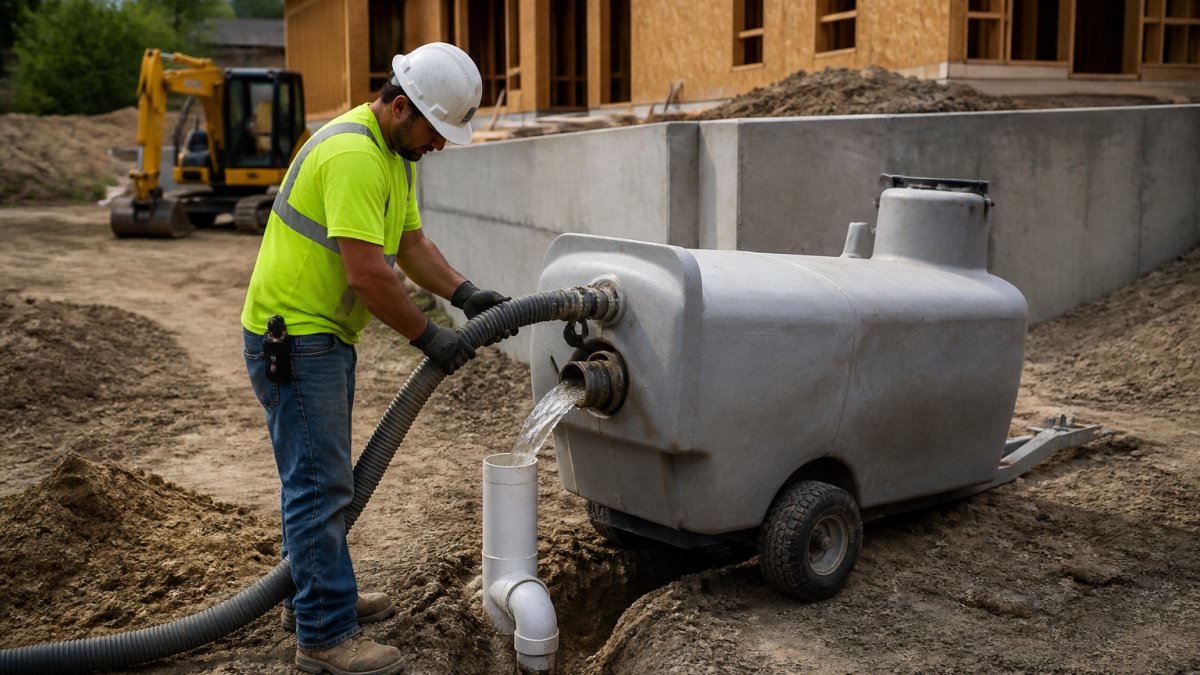
Portable restroom service frequency depends on guest count, hours, and heat. For a single-day event, one mid-event service is a sensible baseline for larger crowds. Multi-day events need servicing before each day.
Waste capacity is the real limit. A unit that looks fine can be near full by mid-afternoon on a hot day.
- Small events, under 4 hours: one service at the end
- Full-day events: one mid-day pump-out
- Multi-day festivals: service before each day opens
- Hot weather: add an extra service
Use our portable toilet cleaning checklist for event organizers to hold your provider and staff to a clear standard.
Map Placement, Accessible Routes, and Contingency Capacity
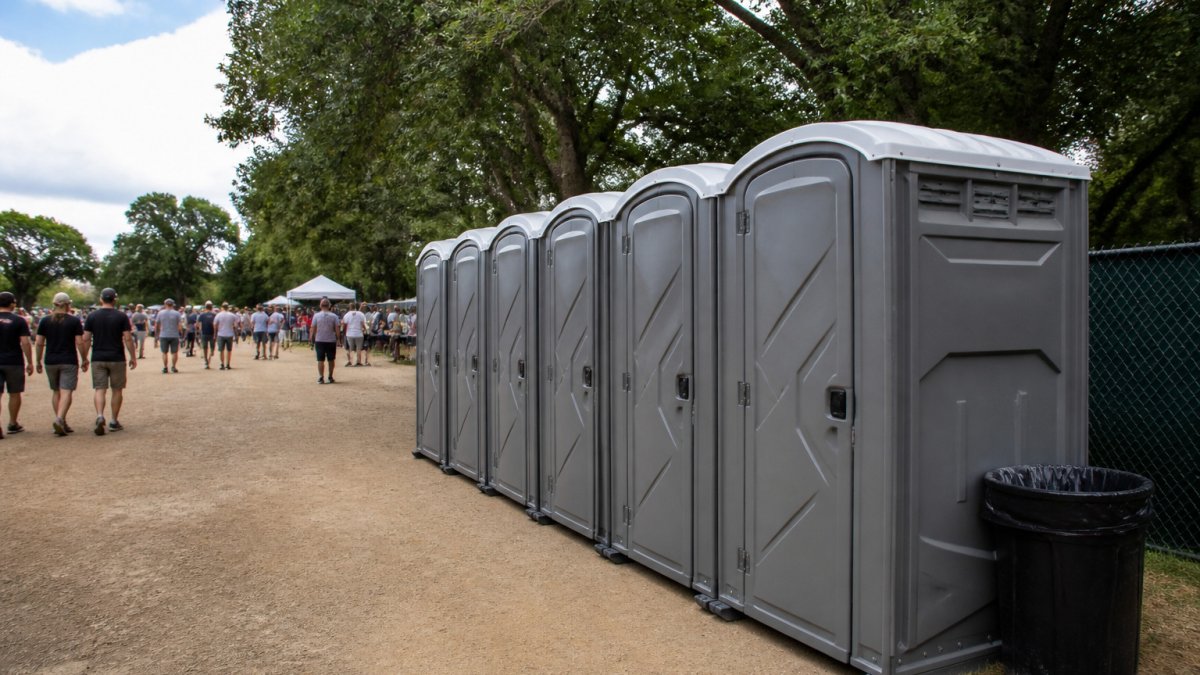
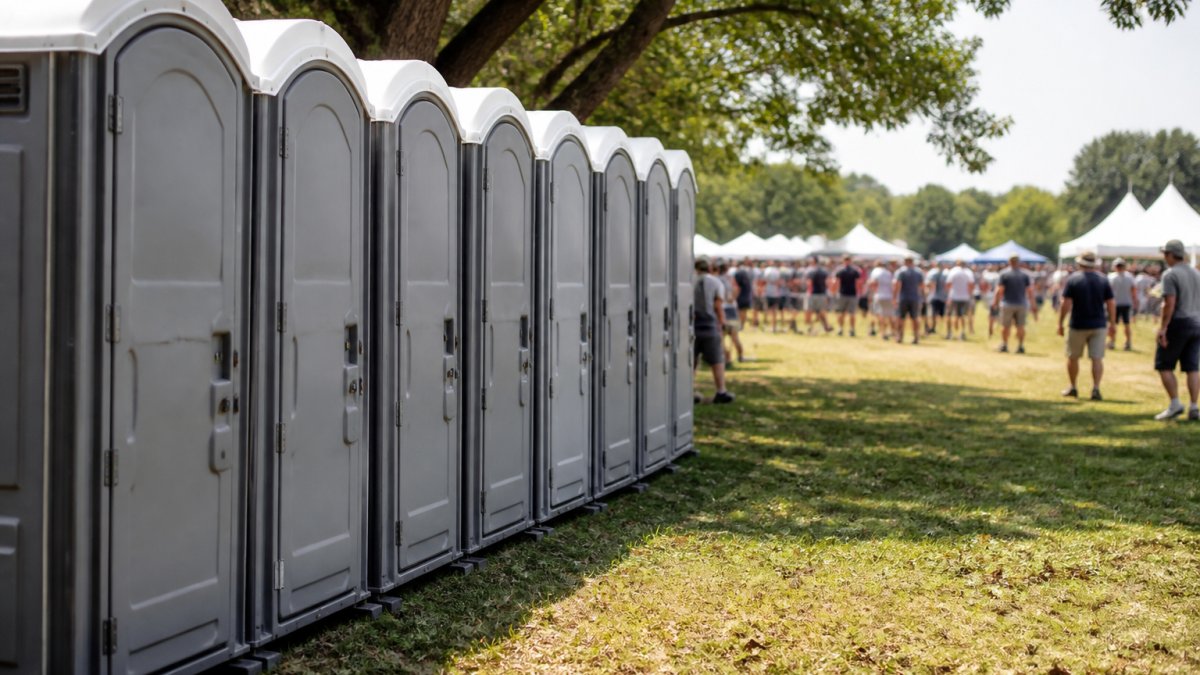
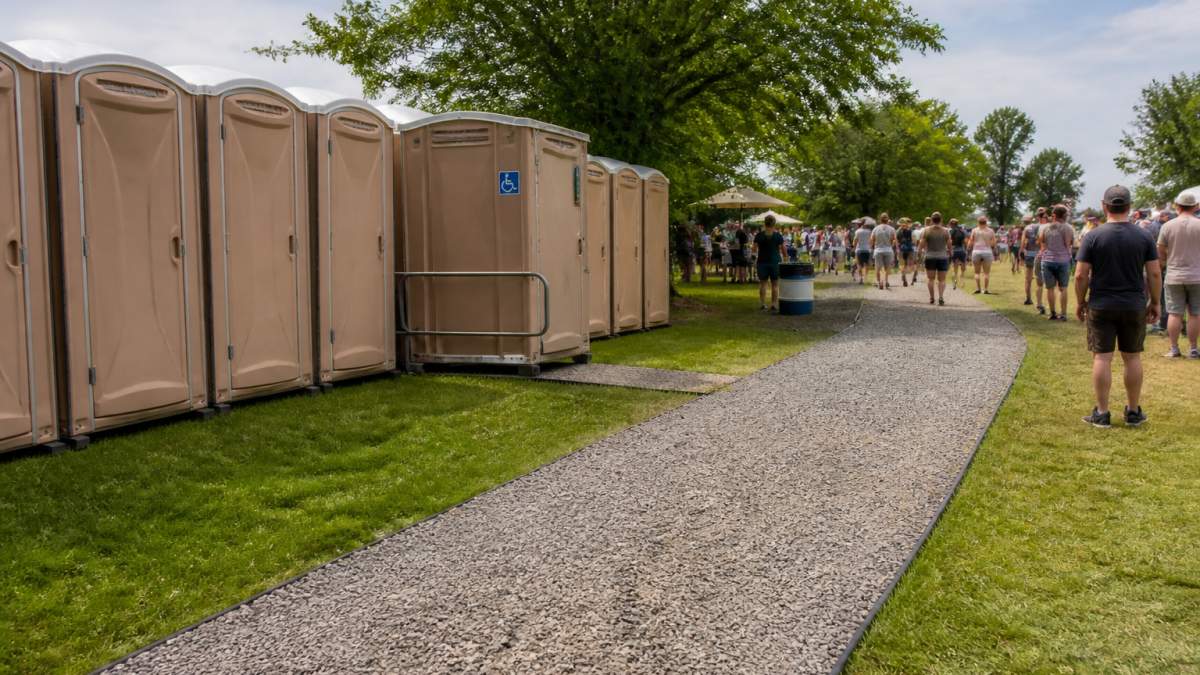
Placement decides whether your unit count actually works. Units clustered in one corner create queues even when the total count is right. Spread them across the site, near but not inside high-traffic areas.
Distribute Units by Traffic, Not by Convenience
A practical rule is to place restroom clusters where people already gather and where they will pass on the way in and out. That usually means entrances, stage areas, food and bar zones, and camping or parking edges. Split the total count across those zones in proportion to expected foot traffic rather than splitting it evenly.
Keep clusters slightly off the main path so queues do not block walkways, but close enough that guests can see them. A unit hidden behind a vendor row will be underused while another cluster overloads.
Keep Accessible Routes Clear
Accessible units need a firm, level path and enough turning space. A unit parked in soft grass or at the end of a muddy track is not accessible, even if it is labeled that way. Route the accessible path from the main entrance and from seating areas, and keep it free of cables, stakes, and vendor clutter. Check the path after setup, not just on the site plan.
Size a Reserve, Not Just a Spare
Contingency capacity is the part most plans skip. Attendance spikes, a broken unit, or a delayed service can turn a good plan into a bad afternoon. A reserve of one or two units works for smaller events; larger events should plan a reserve equal to roughly 10 percent of the working count, plus a confirmed delivery window for backups.
- Keep one or two spare units on site for smaller events
- For larger events, hold a reserve near 10 percent of the working count
- Confirm a delivery window for backups before the event
- Have a plan for a unit that goes out of service
- Check routes so service trucks can reach every cluster
A reserve unit that cannot be reached by a service truck is not a reserve. Walk the service route before the gates open and confirm every cluster has clear access.
Local rules vary by site and jurisdiction. Check with your local health department on permit and placement requirements before the event, since CDC guidance on sanitation at mass gatherings treats restroom access as a core public health concern.
Frequently Asked Questions
How many porta potties do you need for 100 people at an outdoor event?
Start with the baseline of one unit per 50 guests for a four-hour event, which gives you two portable toilets for 100 people. Add units if the event runs longer than four hours, if alcohol is served, or if attendance will spike during a program or headliner set. For a 100-person wedding with dinner and drinks lasting six hours, planning three to four units gives you a buffer for peak usage and keeps wait times short.
How often should portable toilets be serviced during a large event?
For a single-day event, one service visit before guests arrive is usually enough when unit counts match attendance. Multi-day festivals need daily servicing, and high-traffic events with alcohol may need mid-day pump-outs. Service frequency depends on waste capacity, guest count, and event length, so confirm the schedule with your provider before the event. Ask whether extra service visits are available if attendance runs higher than expected.
How should you account for food and alcohol when estimating event restroom needs?
Food and drink increase restroom traffic, and alcohol raises it further because guests drink more and visit more often. Add roughly 15 to 20 percent more units when a full meal is served, and more when alcohol is flowing. Schedule the extra capacity around meal service and bar hours, since those windows create the heaviest queues. A portable restroom calculator that includes food and beverage inputs helps you size the buffer without guessing.
How many accessible portable restrooms should an outdoor event provide?
Plan at least one ADA-accessible unit for every cluster of restrooms, and more for large events with multiple restroom zones. Accessible units need a firm, level route from the main event area, not a muddy path or a spot behind a fence. Check local permit requirements for your event size, since some jurisdictions set specific accessible-unit counts. Confirm with your provider that accessible units are included in your order, not added later.