 blog
blog
Essential Amenities for Luxury Wedding Restroom Trailers
Table of Contents
- Why Luxury Wedding Restroom Trailers Change Guest Experience
- Essential Amenities for Luxury Wedding Restroom Trailers: The Full Checklist
- Choosing a Restroom Trailer for an Outdoor Wedding
- Portable Restroom Trailer Capacity: How Many Stalls Do You Need?
- Restroom Trailer Power and Water Requirements Before Delivery
- Accessibility, Hygiene, and Keeping the Trailer Clean During the Event
- What to Confirm With Your Rental Provider Before the Big Day
- Frequently Asked Questions
Last Updated: October 6, 2026
Why Luxury Wedding Restroom Trailers Change Guest Experience
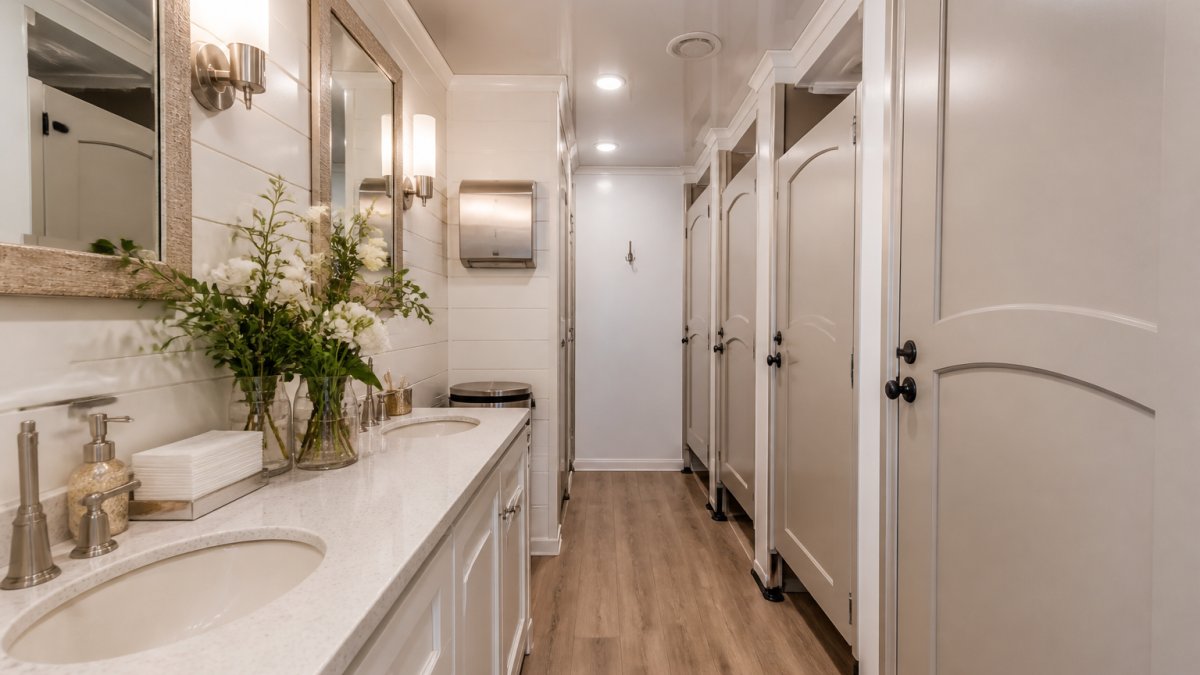
A luxury wedding restroom trailer is a mobile unit built to feel like a nice hotel bathroom, with flushing toilets, running water, and climate control.
Guests remember two things about an outdoor venue: how the ceremony felt, and whether the restroom was a problem.
Below, we cover the amenity checklist, how many stalls you need, and what to confirm before delivery day.
Essential Amenities for Luxury Wedding Restroom Trailers: The Full Checklist
These amenities separate a true luxury wedding restroom from a basic portable unit. Use this list when comparing rental options.
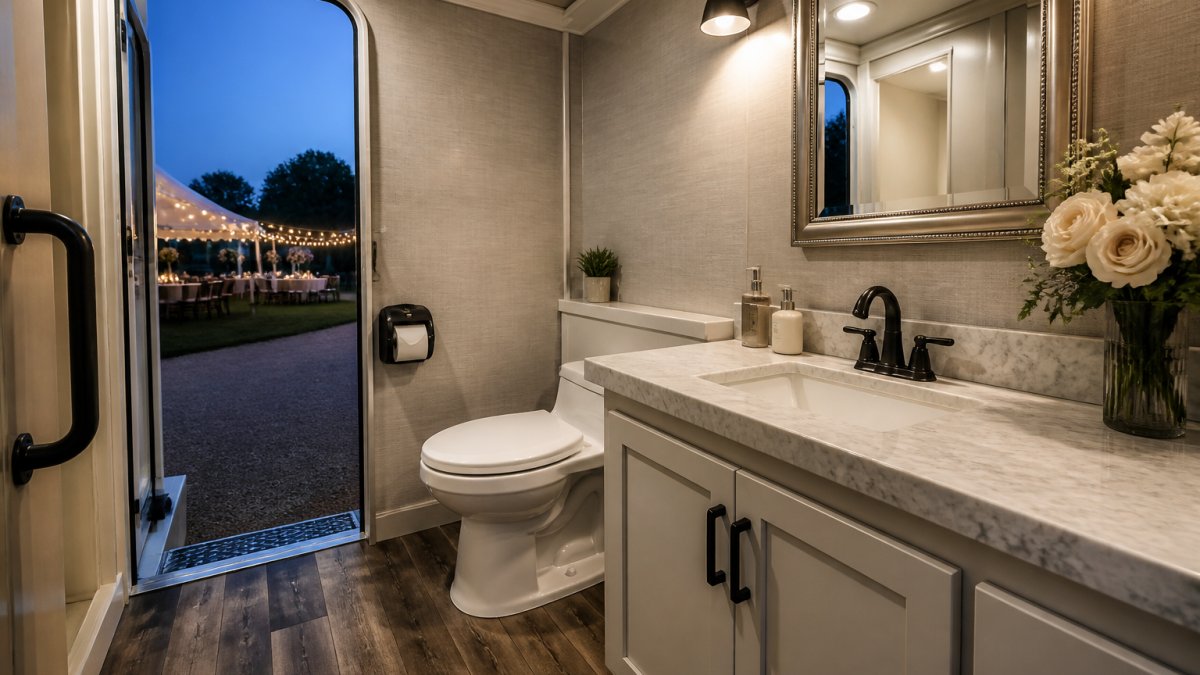
Flushing Toilets, Running Water, and Handwashing Stations
A porcelain flushing toilet is the baseline, it behaves like the one at home, so guests never think about it.
Running water matters just as much: a sink with a working faucet, hand soap, and paper towels or a dryer turn a quick stop into a normal routine. Stock supplies generously, running out mid-reception is the most avoidable failure on this list.
Climate Control, Lighting, and Vanity Mirrors
Air conditioning and heating keep the interior comfortable in any season, while a vent fan controls odor and moisture at peak use.
Interior lighting should be bright enough to check makeup and read a sign, and a vanity mirror with a small counter gives guests room to freshen up.
Some units add Bluetooth audio, which covers the one thing thin trailer walls don't: sound privacy.
| Amenity | Why It Matters | Look For |
|---|---|---|
| Flushing porcelain toilet | Familiar, clean experience | One per stall, working flush |
| Sink and handwashing station | Basic hygiene | Running water, soap dispenser |
| Paper towels and toilet paper | Prevents mid-event shortages | Stocked plus backup supply |
| Air conditioning and heating | Comfort in any season | Unit sized to guest count |
| Vent fan | Controls odor and moisture | Runs continuously |
| Interior lighting | Safety and usability at night | Bright, even, no dark corners |
| Vanity mirror and counter | Space to freshen up | Lit mirror, sturdy surface |
| Bluetooth audio | Sound privacy | Optional, low volume |
Choosing a Restroom Trailer for an Outdoor Wedding
Match the trailer to your venue before your guest count. A restroom trailer for an outdoor wedding needs a level pad, a clear path, and room for the delivery truck to turn around.
Walk your site with these questions:
- Is the ground level and firm enough to support a loaded trailer?
- Can a truck reach the spot without crossing soft grass or a narrow gate?
- Is there a clear, lit path for guests after dark?
Distance is the detail couples regret most. A trailer 200 feet from the tent feels fine in daylight and endless at night in heels. Place it within sight of the reception, but not so close that guests hear every door.
Portable Restroom Trailer Capacity: How Many Stalls Do You Need?
The common starting point is one stall per 50 guests, but that assumes a short, low-alcohol event. For a wedding, plan around peak load: most guests visit during arrival, the end of the ceremony, and the last hour of the reception.
Use this as your baseline, then adjust upward:
| Guest Count | Minimum Stalls | Comfortable |
|---|---|---|
| Up to 50 | 1 | 2 |
| 50 to 100 | 2 | 3 |
| 100 to 150 | 3 | 4 |
| 150 to 200 | 4 | 5 to 6 |
| 200 to 250 | 5 | 6 to 8 |
| 250 to 300 | 6 | 8 to 10 |
Three variables push you to the higher number:
- Event duration. A six-hour reception with a cocktail hour and after-party needs more than a four-hour one. Add one stall for every two hours beyond four.
- Alcohol service. A full bar increases restroom frequency. With a hosted bar, round up, and add a stall if it's open the entire reception.
- Season and weather. In heat, guests drink more and visit more often; in cold, they linger inside longer. Both argue for one extra stall.
A practical rule: add one stall for any event over four hours, with a full bar, or in extreme heat or cold, the cheapest insurance against a queue you'll hear about later.
How Stall Count Translates to Trailer Size
Stalls don't map one-to-one to trailers. A two-stall trailer is usually a single-axle unit that fits a tight driveway; a four-stall is typically tandem-axle and needs a wider path and larger pad.
Ask your provider how many stalls each trailer actually has, not how many "stations" or "doors" it advertises. A unit marketed as a four-station trailer may have two toilets and two urinals, which changes the math for a mixed-gender guest list.
Queues, Not Counts, Are What Guests Remember
A queue of more than a few minutes is the failure guests notice. Two smaller trailers on opposite sides of the venue often beat one large trailer in a single spot, because walk time and queue time both drop. If your venue has separate cocktail and reception areas, consider whether guests will walk back to one restroom block after dark.
Restroom Trailer Power and Water Requirements Before Delivery
Utility planning is where most outdoor wedding restroom setups succeed or fail. A luxury trailer needs power for lighting, climate control, the vent fan, and the water pump, plus a water source and a waste plan. Confirm all three before signing the rental agreement.
Power: Outlet, Generator, or Both
Most trailers run on a standard 120-volt household-style connection, but amperage draw matters: a trailer with summer air conditioning pulls far more than one running lights and a vent fan in spring.
If the venue has no power at the restroom spot, a generator is the answer. Two practical points:
- Generator placement. Keep it away from the reception tent and the trailer door. Generators are loud, and guests will notice a unit humming next to the vanity mirror.
- Fuel and runtime. Confirm the generator can run for the full event plus setup and breakdown, and who refuels it if the event runs long.
If venue power is far from the restroom spot, ask whether the provider supplies extension cabling rated for the load, a long run of undersized cable commonly trips breakers mid-reception.
Water: Spigot Connection or Onboard Tank
Two setups are common:
- Direct connection. A hose runs from a venue spigot to the trailer, simplest when a spigot is close and the water is potable.
- Onboard fresh water tank. The trailer carries its own supply, right when no spigot is available or the run would cross a guest path. Tank capacity limits flushes and handwashes, so ask for the tank size and estimate use against your guest count.
With a direct connection, protect the hose run: a hose crossing a walkway is a trip hazard after dark, and one crossing a lawn can kill grass. Route it along a fence line or under a mat.
Waste: Holding Tanks and Mid-Event Servicing
Most luxury trailers use holding tanks pumped out after the event; longer events or larger guest counts may need a mid-event pump-out. Ask three questions:
- How many gallons do the waste tanks hold?
- At what guest count or event length does a mid-event pump-out become necessary?
- Is the pump-out included, or is it a separate charge?
A sewer connection avoids the pump-out entirely but requires a sewer access point near the trailer. If your venue has one, confirm the connection type and whether the provider supplies fittings.
Placement: Level Ground, Access, and Distance
A loaded restroom trailer is heavy, and it needs level ground. A slope of more than a few degrees can affect door operation, tank sensors, and guest footing. Walk the site with these questions:
- Is the ground level and firm enough to support a loaded trailer?
- Can a truck reach the spot without crossing soft grass, a narrow gate, or a low branch?
- Is there a clear, lit path for guests after dark?
Distance is the detail couples regret most. A trailer 200 feet from the tent feels fine in daylight and endless at night in heels. Place it within sight of the reception, but not so close that guests hear every door.
The Servicing Plan Belongs in the Contract
Utility planning and servicing are the same conversation. Before signing, confirm who handles setup and leveling, who supplies power and water connections, whether a mid-event pump-out or restock is included, and what happens if a unit has a problem mid-event. Get delivery and pickup windows in writing, not just the day.
Accessibility, Hygiene, and Keeping the Trailer Clean During the Event
An accessible restroom is not optional. Check the ADA Standards for Accessible Design for the door width and clear floor space requirements that apply to your setup.
Accessibility also covers the path. A ramp, firm ground, and good lighting get a guest with a walker or wheelchair to the door without help.
Cleanliness holds up with a simple routine:
- Assign one person to check the trailer every hour or two.
- Restock toilet paper, paper towels, and soap before levels run low.
- Wipe counters and spot-clean floors between checks.
A trailer that starts spotless and stays that way is the whole point of renting luxury.
What to Confirm With Your Rental Provider Before the Big Day
Get every detail in writing before you sign. A dependable provider answers these without hesitation.
- Delivery and pickup windows. Know the exact times, not just the day.
- Setup and leveling. Who handles it, and who supplies the power and water connections?
- Servicing during the event. Is a mid-event pump-out or restock included?
Ask for references from other weddings or events in the area. A provider who does this well will have them ready.
Frequently Asked Questions
What amenities should a luxury wedding restroom trailer include?
A luxury wedding restroom trailer should include flushing porcelain toilets, running-water sinks with soap dispensers, paper towels, toilet paper, climate control through air conditioning and heating, interior lighting, vanity mirrors, and ventilation fans. Higher-end units add marble countertops, hardwood floors, and Bluetooth audio. For an outdoor wedding, confirm the trailer has a fresh water supply, waste tank capacity, and a power source before booking, since these determine whether the unit runs properly all day.
How many restroom trailer stalls do you need for a wedding?
Plan for roughly one restroom stall per 50 guests for a four-hour event. A 100-guest wedding with a six-hour reception and bar service needs more capacity than the same guest count at a dry, three-hour ceremony. Portable restroom trailer capacity also depends on whether guests have access to indoor facilities. If the venue has none, size up. Ask your rental provider to match stall count to guest count, event duration, and whether alcohol is served.
What power and water hookups does a wedding restroom trailer need?
Most restroom trailers need a 110-volt or 220-volt power source and a potable water connection, though many units run on onboard generators and fresh water tanks. Confirm restroom trailer power and water requirements with your provider before the event. If the venue has no hookups, the trailer must arrive with a full water tank and enough generator fuel for the full event. Ask about amperage, hose length, and whether the trailer needs a dedicated circuit.
How do you keep a restroom trailer clean during a wedding?
Schedule at least one mid-event service visit for weddings over four hours. That visit should include restocking toilet paper, soap, and paper towels, emptying waste tanks if needed, and wiping down counters and fixtures. Place a sanitizing solution and extra supplies inside the trailer for quick touch-ups. Ventilation fans help control odors between service visits. Confirm with your rental provider whether attendants are included or available as an add-on for larger events.
Planning an outdoor wedding means juggling a hundred details, and the restroom plan should not be one you worry about. Patriot Solutions delivers clean restroom trailers, dependable local service, and fast delivery across the Delta area, with equipment built for real events and a team that shows up when promised. Get started with Patriot Solutions and give your guests a restroom experience that matches the rest of your day.